


By NewsRum Tech Desk Published: March 23, 2026
The landscape of generative artificial intelligence in the United Kingdom has been fundamentally redrawn. In a move being hailed as a defining victory for the creative industries, the UK government has officially executed a massive strategic “U-turn” on AI copyright laws.
On March 18, 2026, the Department for Science, Innovation and Technology (DSIT) published its long-awaited Report on Copyright and Artificial Intelligence, a document mandated by the Data (Use and Access) Act 2025. Moving decisively away from previous proposals that favored frictionless AI development, the government confirmed it has dropped its “preferred option” of a broad copyright exception for AI training.
The Core of the Controversy: Opt-Out vs. Opt-In
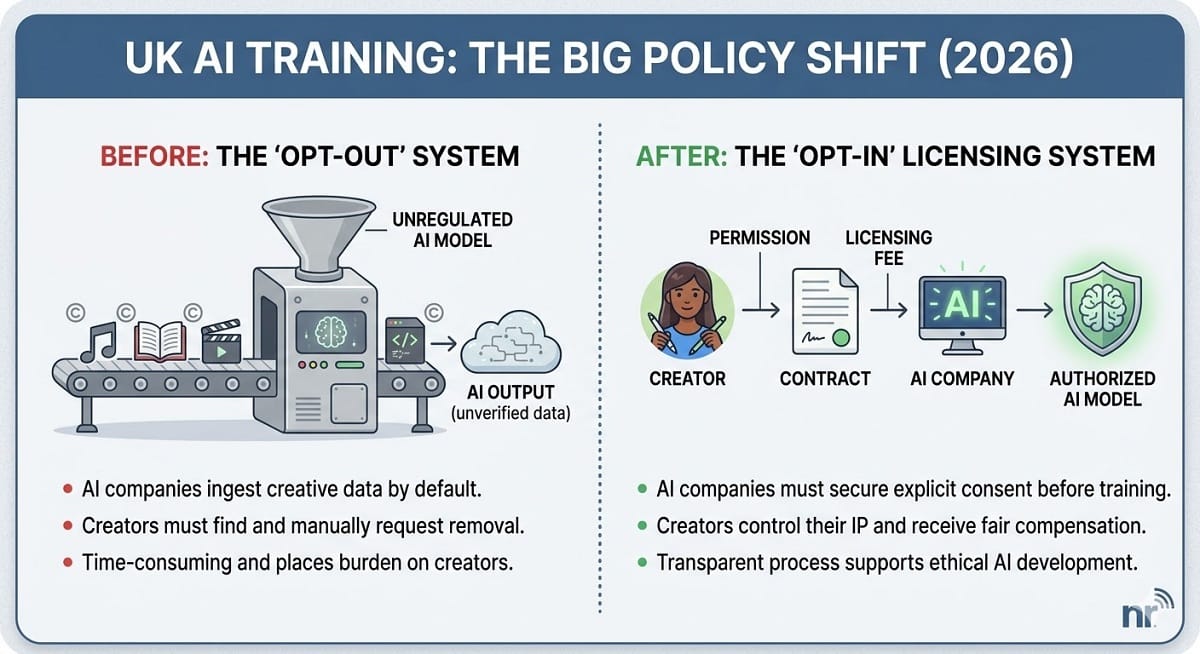
To understand why this shift is seismic, one must look at the trajectory of the 2025 consultation. The government’s initial preferred solution was a “Text and Data Mining” (TDM) exception with a rightsholder opt-out. This would have allowed AI developers to scrape copyright-protected works by default, unless a creator manually “opted out”—a process industry leaders described as an impossible administrative burden.
However, the DSIT report revealed a staggering level of opposition. According to the government’s figures, nearly 97% of respondents rejected the opt-out model. “We have listened,” stated Technology Secretary Liz Kendall in the official release. “A broad copyright exception with opt-out is no longer the government’s preferred way forward.”
The New Reality: A “Licensing-First” Mandate
The government’s pivot aligns with the “licensing-first” approach recently urged by the House of Lords Communications and Digital Committee. The default position in the UK is shifting back toward the protection of original human expression.
This means that any AI developer seeking to utilize UK-copyrighted works must now navigate a landscape where explicit permission and fair compensation are the expected norms. As noted by Hogan Lovells legal analysts, this marks a “clear retreat” from the position the government adopted in late 2024.
Infographic: UK AI Training: The Big Policy Shift (2026)
This chart, based on data from the House of Lords Library, illustrates the shift from a “Scrape-First” model to a “Consent-First” marketplace.
Why the Change Happened: The “Creative Backlash”
The catalyst for this U-turn was not a technological breakthrough, but a sustained political and social campaign by the UK’s powerhouse creative sector, which contributes over £115bn annually to the economy.
Organizations like the Society of Authors, the BPI (representing the UK music industry), and the National Union of Journalists launched relentless lobbying efforts. High-profile lawsuits in the US (such as The New York Times vs. OpenAI) provided a stark legal backdrop, demonstrating the potential liability if the UK maintained a laissez-faire approach.
Government insiders suggest that ministers became convinced that a weak IP regime would actively damage the UK’s reputation as a global creative hub. The “Future Tech” potential of AI had to be balanced against the “Current Value” of human output.