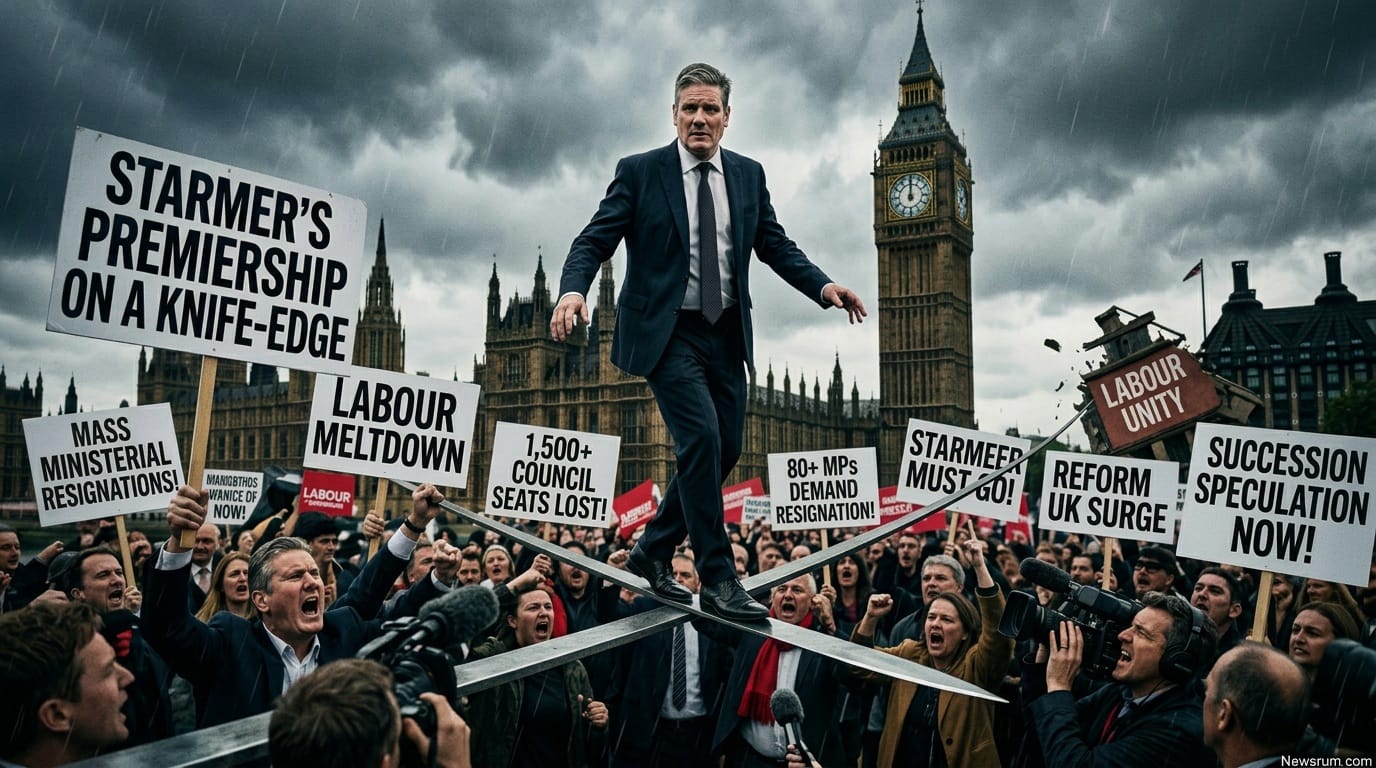


STARMER’S PREMIERSHIP ON A KNIFE-EDGE: LABOUR MELTDOWN TRIGGERS MASS MINISTERIAL RESIGNATIONS AND SUCCESSION SPECULATION
Prime Minister Defiant as 80+ MPs Demand Resignation; UK Borrowing Costs Surge Amid Political Chaos
May 13, 2026 — British Prime Minister Keir Starmer’s political career hangs by a thread as his government descends into chaos following Labour’s catastrophic performance in last week’s local elections. With nearly 80 Labour Members of Parliament openly calling for his resignation and multiple cabinet ministers quitting in protest, political analysts are now openly questioning whether Britain’s prime minister will survive the year—a scenario that would represent an unprecedented crisis for a sitting Labour prime minister.
The extraordinary political implosion, triggered by Labour’s loss of approximately 1,500 council seats to the far-right Reform UK party, has sent shockwaves through Westminster and destabilized financial markets, with UK government borrowing costs surging to their highest level since 2008.
THE ELECTION DISASTER THAT SPARKED A REBELLION
About 5,000 seats were up for grabs across 136 council elections on Thursday. The Labour Party won just over 1,000 of the seats that were contested, losing more than 1,100 seats that it had previously held. Meanwhile, the right-wing populist Reform UK party gained more than 1,400 seats.
The scale of Labour’s defeat was staggering. Labour lost nearly 1,500 seats in English councils, while the hard-right Reform UK party won a total of 1,454 seats in England. For a government elected just two years ago in a landslide victory, the reversal represents a historic collapse in public support.
Sources:
- NPR – Keir Starmer’s party lost big in U.K. local elections
- CNN – UK Prime Minister Keir Starmer faces critical cabinet meeting amid calls to resign
MAKE-OR-BREAK SPEECH BACKFIRES
In an attempt to stem the bleeding, Starmer delivered what was billed as a “make-or-break” speech on Monday, May 11, in which he took responsibility for Labour’s performance while arguing that the government’s “fundamentals are sound.”
In the speech, Starmer took responsibility for the “very tough” results, promising to “face up to the big challenges” and “make the Labour case” for a “stronger, fairer Britain”. Admitting that Labour had made mistakes, he argued that its big political choices had been correct, including not being dragged into the US-Israel war on Iran.
However, the speech proved catastrophically ineffective. “Starmer’s attempt to quell a rebellion against his leadership has failed,” Eurasia Group analysts noted. Instead of rallying his party, the address triggered a wave of ministerial resignations and intensified calls for his departure.
Sources:
THE RESIGNATION TSUNAMI BEGINS
Within hours of Starmer’s Monday speech, ministerial resignations began cascading through the government. By Tuesday morning, multiple junior ministers had quit their posts, each citing loss of confidence in the prime minister’s leadership.
Key Resignations:
Miatta Fahnbulleh resigned as junior minister for devolution, faith and communities saying Starmer had “lost the trust and confidence of the public”. Safeguarding minister Jess Phillips also stepped down, saying she was “not seeing the change I think I and the country expect” and could not continue to serve under the current leadership. Zubir Ahmed, parliamentary under-secretary of state in the Department of Health and Social Care, became another junior minister to resign, saying Starmer’s “lack of values-driven leadership” was undermining government achievements.
Alex Davies-Jones, British minister for Victims & Violence Against Women and Girls, also resigned on Tuesday, calling on the prime minister to step down after “catastrophic” electoral defeats.
The resignations indicated growing fractures within Starmer’s cabinet itself. The Telegraph newspaper reported that six cabinet members were telling Starmer to step down: Foreign Secretary Yvette Cooper, Home Secretary Shabana Mahmood, Defence Secretary John Healey, Energy Secretary Ed Miliband, and Culture Secretary.
Sources:
- Al Jazeera – Starmer defiant at cabinet meeting amid growing pressure to resign
- Washington Post – UK’s Starmer defiant as calls for his resignation grow and several ministers quit
80+ MPs CALL FOR DEPARTURE
The rebellion within Parliament has reached critical mass. At least 83 of the total 403 Labour MPs have called for Starmer to step down, a significant portion of the Labour caucus that signals deep-rooted dissatisfaction with his leadership.
The threshold for triggering a formal leadership challenge is substantial—a leadership contest requires the endorsement of 81 Labour MPs—meaning Starmer is perilously close to facing a formal challenge. However, there appears to be no consensus among Labour Party lawmakers on who should replace him, which may provide the prime minister temporary reprieve.
Sources:
STARMER VOWS TO FIGHT ON
In a tense cabinet meeting on Tuesday morning, Starmer insisted he would not resign and accused his opponents of destabilizing the government. Starmer told his cabinet he would remain in office despite growing calls for his resignation, saying the process for challenging the leader of the Labour Party has not been triggered, telling ministers: “The country expects us to get on with governing”.
However, his defiance masked internal divisions. The cabinet was reported to be divided over whether he should remain on, and his leadership team was reportedly split on what the PM should do next.
Some cabinet allies offered tepid support. Secretary of State for Business and Trade Peter Kyle said “Keir is showing steadfast leadership”, while others remained conspicuously silent on the question of his future.
SUCCESSION STAKES: WHO COULD REPLACE HIM?
Should Starmer be forced out, potential successors have already begun positioning themselves. Potential challengers to the leadership include Health Secretary Wes Streeting, former Deputy Prime Minister Angela Rayner and Greater Manchester Mayor Andy Burnham.
Wes Streeting: The current Health Secretary and ally of several resigning junior ministers, particularly Zubir Ahmed, is viewed as a potential challenger from the centre-right of the Labour Party.
Angela Rayner: The influential former Deputy Prime Minister has already signaled discontent, stating that “What we are doing isn’t working, and it needs to change. This may be our last chance”.
Andy Burnham: The Greater Manchester Mayor is seen as representing a more regional, working-class alternative to the London-based political establishment.
However, the lack of clear consensus around any single candidate could itself prove destabilizing, as Labour seeks to rally behind a new leader.
Sources:
THE BROADER FAILURE: POLICY MISSTEPS AND SCANDALS
Starmer’s leadership crisis is not solely the result of electoral defeat; multiple policy failures and scandals have eroded public and party confidence.
The Mandelson Fiasco: Mandelson, a veteran Labour Party politician, has been accused of passing market-sensitive information to convicted sex offender Jeffrey Epstein when he was business secretary in the UK government. Mandelson was fired after seven months as Britain’s ambassador to the United States, with Starmer admitting to parliament that he shouldn’t have appointed Mandelson to the plum diplomatic role.
The scandal deepened when it was revealed that Peter Mandelson was refused a security clearance but became British Ambassador to the U.S. anyway, raising serious questions about Starmer’s judgment and his government’s vetting procedures.
Mandelson was arrested Monday on suspicion of misconduct in public office and later released on bail, adding a criminal dimension to the political scandal.
Cost-of-Living Failures: Discontent among Labour MPs and large sections of the electorate has centered on the government’s apparent failure to contain illegal immigration, particularly by boats crossing the English Channel, and unpopular efforts to cut welfare spending.
Most damaging has been the decision to cut the winter fuel allowance amid a cost-of-living crisis, a policy that directly undermined Labour’s core support among working-class and elderly voters.
The Gaza Question: Labour’s policy on Gaza has also contributed to eroding support, particularly among younger voters and communities concerned about Middle Eastern affairs.
Antisemitism Crisis: A surge in antisemitism that the government has declared a “national emergency” represents an additional governance failure, with Starmer’s government struggling to manage communal tensions.
Sources:
- CNN – Peter Mandelson arrested amid Epstein probe
- NBC News – Former UK ambassador to US released on bail after arrest in Epstein investigation
- CNBC – UK MPs are turning on PM Starmer
FINANCIAL MARKETS IN FREEFALL
Investors have reacted with alarm to the political turmoil. In a sign of markets’ disquiet over the precarious political situation, U.K. government borrowing costs surged on Tuesday morning to their highest level since 2008.
The surge in UK gilt yields reflects fundamental concern about the stability of the British government and its ability to manage the economy during a period of heightened geopolitical uncertainty. Financial markets abhor political uncertainty, and the spectacle of a government in freefall creates significant economic risks.
Sources:
THE REFORM UK THREAT: END OF TWO-PARTY POLITICS
Meanwhile, the right-wing populist Reform UK party gained more than 1,400 seats. Other parties recorded smaller wins, with the Green Party gaining more than 300 seats and the Liberal Democrats more than 150. The Conservative Party — traditionally Britain’s other dominant political force alongside Labour — also performed badly, losing over 500 seats.
The election results represent a fundamental realignment of British politics. Reform recorded victories across the country, taking over Essex county council in the south, Havering — its first London local authority — and the northern English city of Sunderland.
Reform UK leader Nigel Farage celebrated his party’s victories, writing in a newspaper column that they signaled an “end of the old establishment’s two-party system”.
This shift presents both an immediate threat to Labour’s electoral prospects and a longer-term reconfiguration of British politics, potentially heralding an era of more fragmented, multi-party competition.
Sources:
HISTORICAL PRECEDENT: NO SITTING LABOUR PM HAS FACED THIS BEFORE
The current crisis is unprecedented in modern British political history. “If Starmer goes, it will make history. No sitting Labour PM yet has ever faced a leadership challenge or been removed by his party”.
This historical fact underscores just how extraordinary the current situation has become. While Conservative prime ministers have faced leadership challenges and forced resignations (Margaret Thatcher in 1990, Liz Truss in 2022), Labour has avoided this form of internal party coup.
The precedent-breaking nature of the current crisis makes the outcome unpredictable and potentially destabilizing for British governance.
THE KING’S SPEECH: A TEMPORARY RESPITE?
One factor potentially extending Starmer’s runway is the ceremonial necessity of the King’s Speech scheduled for Wednesday, May 13. Whether the imminence of the King’s Speech gives Keir Starmer staying power remains to be seen. None of his potential rivals have yet formally challenged his leadership. Perhaps the prospect of having to play happy families in front of the monarch Wednesday morning will persuade those rivals to bide their time for another day.
This constitutional event may provide Starmer with a brief pause in the immediate pressure, but it is unlikely to resolve the underlying issues driving the rebellion.
WHAT HAPPENS NEXT?
The coming days will be crucial for determining Starmer’s political future. Several scenarios are possible:
Scenario 1: Formal Leadership Challenge — If 81 or more Labour MPs formally nominate a challenger, Starmer would face a party-wide vote in which all Labour members could participate. This would be an open test of his party support.
Scenario 2: Negotiated Departure — Facing insurmountable pressure, Starmer could agree to set a timetable for his departure, preserving some dignity while allowing Labour to organize an orderly succession.
Scenario 3: Brief Respite — Starmer survives the immediate crisis but remains permanently weakened, struggling to govern effectively as an embattled lame-duck prime minister.
Scenario 4: Defiant Endurance — Starmer digs in, refuses all pressure, and seeks to rebuild momentum through new policy initiatives and a major cabinet reshuffle.
Political analysts at Eurasia Group, however, believe the trajectory is clear. Although he may remain a few more months in Downing Street, he is still fighting for his political life.
IMPLICATIONS FOR BRITAIN
Whether or not Starmer survives, British governance has been severely damaged. The revelations about the Mandelson scandal, the apparent incompetence evident in his vetting, and now the political chaos all raise fundamental questions about the quality and judgment of Britain’s governing class.
For the British public, facing economic uncertainty, cost-of-living pressures, immigration challenges, and communal tensions over antisemitism and Gaza, the spectacle of a government in freefall offers no reassurance that their problems are being seriously addressed.
The question now is whether a new Labour leader could rebuild trust and credibility, or whether the party has experienced such profound damage that electoral defeat becomes inevitable at the next general election, likely to be held before May 2029.
SOURCES FOR VERIFICATION
All claims in this article can be independently verified through the following trusted sources:
- CNN
- Live updates: UK Prime Minister Keir Starmer faces critical cabinet meeting amid calls to resign
- Former UK ambassador to US Peter Mandelson arrested amid Epstein probe
- NPR
- Keir Starmer’s party lost big in U.K. local elections. Here’s what comes next
- UK ex-envoy to U.S. Peter Mandelson arrested in Epstein probe
- Al Jazeera
- UK’s Starmer battles for political survival amid calls for exit timetable
- Starmer defiant at cabinet meeting amid growing pressure to resign
- CNBC
- UK MPs are turning on PM Starmer — now analysts say he’s unlikely to last the year
- The Washington Post
- UK’s Starmer defiant as calls for his resignation grow and several ministers quit
- NBC News
- Former UK ambassador to the U.S. released on bail after arrest in Epstein investigation
- PBS News
- British police arrest former ambassador to the U.S. Peter Mandelson in probe into Epstein ties
- UK Parliament Official News
- Parliamentary business updates and committee inquiries
Article Prepared By: Senior News Editor John Cael Date: May 13, 2026 Story Category: Politics, Government Crisis, Investigation Geographic Focus: United Kingdom Tags: Keir Starmer, Labour Party, Leadership Crisis, Reform UK, Local Elections, Political Scandal, Mandelson, Epstein