

Published: February 17, 2026 | Topic: Fortnite, Epic Games, Metaverse, Creator Economy
Most mainstream headlines still talk about Fortnite as a battle royale game where teenagers shoot each other in colorful landscapes. That framing is now laughably outdated. What Epic Games has quietly assembled is something far more significant: a programmable, monetizable, cross-platform virtual universe that is rewriting the rules of gaming, digital commerce, and the open internet — and almost no one outside the tech industry is paying attention.
Here’s what’s actually happening, and why it matters to anyone who cares about creative economies, digital rights, and open technology.
Fortnite Just Returned to Your iPhone — And It’s a Bigger Deal Than You Think
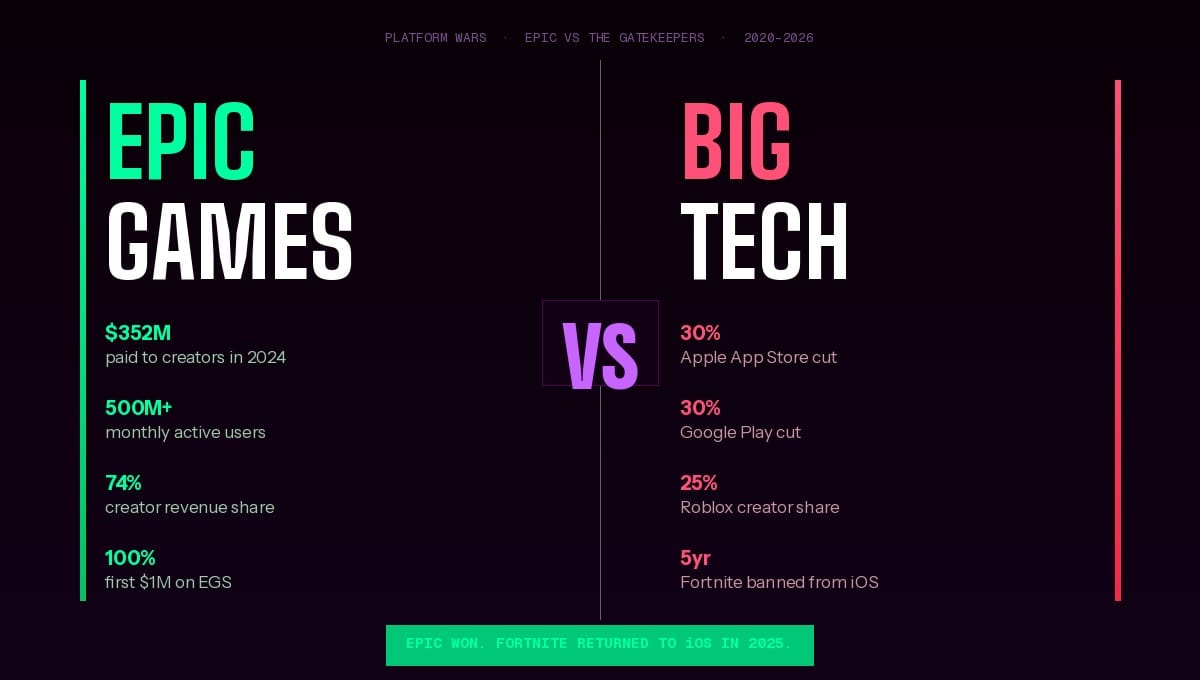
After a landmark five-year exile from Apple’s App Store following Epic’s explosive legal battle over payment processing fees, Fortnite returned to U.S. iOS devices in May 2025 — a quiet win that carried enormous implications for developer freedom worldwide.
The original 2020 showdown was triggered when Epic deliberately bypassed Apple’s 30% transaction fee by offering players direct V-Bucks purchases at a discount. Apple responded by removing Fortnite. Epic sued. The resulting legal saga became a bellwether case for the entire app economy.
The return to iOS isn’t just about Fortnite players getting their game back on their phones. It signals a broader shift in how platform gatekeepers can and cannot control digital commerce. According to Sacra’s Epic Games analysis, the reinstated iOS distribution — combined with a Google settlement finalized in late 2025 — opens Epic’s ecosystem to a significantly wider audience just as its most ambitious product evolution is getting underway.
Key takeaway: The App Store wars produced a real-world precedent. Epic’s willingness to absorb years of lost mobile revenue to fight on principle is starting to pay off — and independent developers everywhere are watching closely.
The Quiet Revolution: Fortnite Creators Can Now Run Real Businesses Inside the Game
In December 2025, Epic flipped a switch that the gaming industry had been waiting years to see. For the first time, creators building custom islands inside Fortnite using the Unreal Editor for Fortnite (UEFN) can sell in-game items directly to players — not relying on Epic’s curated Item Shop, but through their own storefronts, in their own worlds.
The economics are genuinely remarkable. As Outlook Respawn reported, for the promotional period running through the end of 2026:
- Creators receive 100% of V-Bucks value from island sales
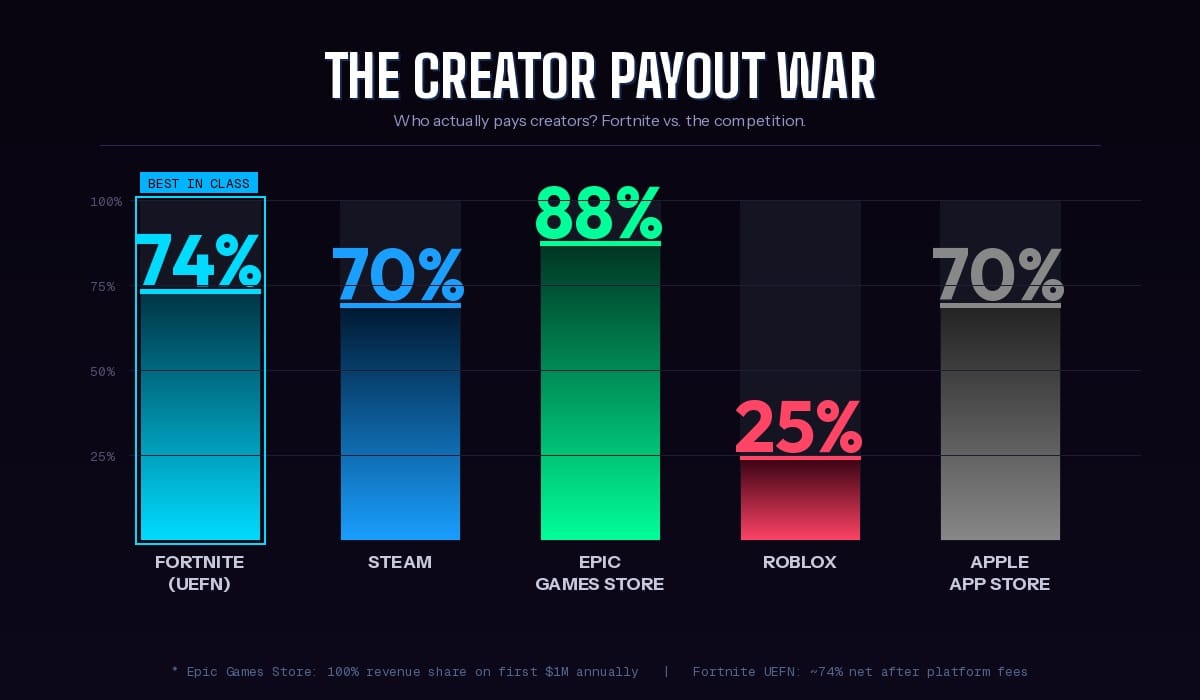
- After platform fees (~26%), that translates to approximately 74% of retail revenue
- Compare that to Roblox’s 25% creator share — the difference is staggering
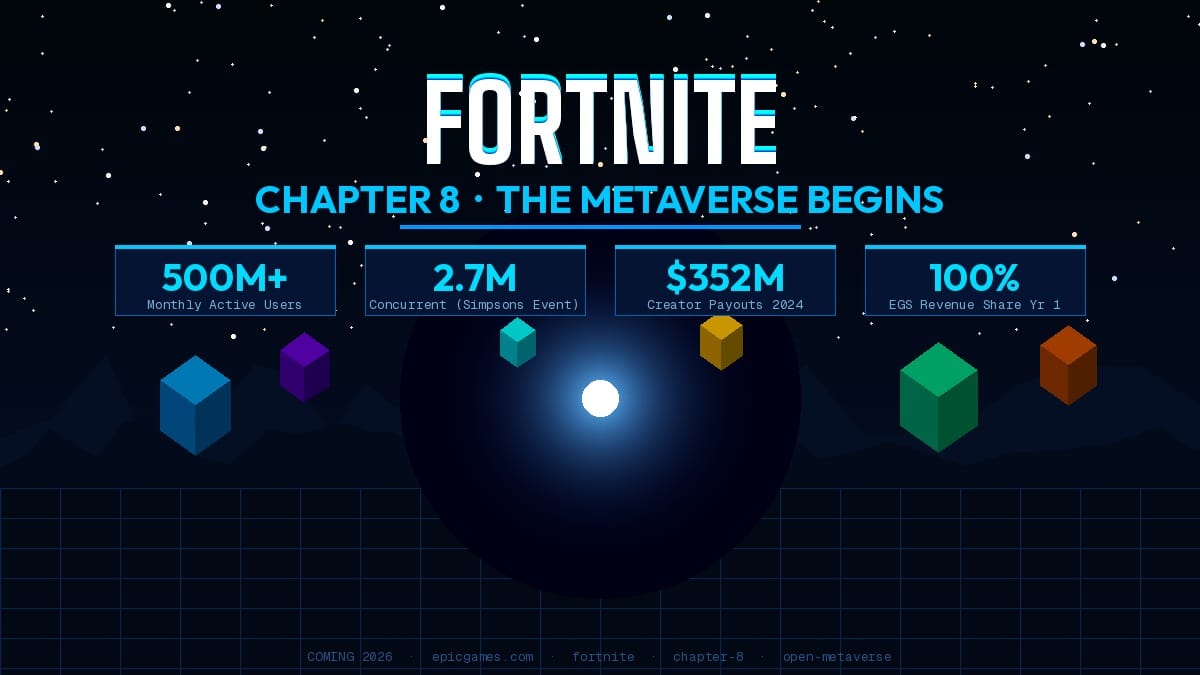
- In 2024 alone, Epic paid out $352 million to creators through engagement payouts
A new “Sponsored Row” feature, launched November 24, 2025, also allows creators to bid for placement in Fortnite’s Discover section — a paid discovery mechanism that sends 100% of that advertising revenue back into the creator payout pool. As GEEIQ noted, brand integrations in Fortnite have been growing at an average of 32% quarter-on-quarter since early 2024.
Key takeaway: Epic is building the infrastructure for independent game developers to earn a living — not just pocket change — inside Fortnite. This is a direct challenge to Roblox’s model and potentially transforms Fortnite into a platform more like a marketplace than a game.
Epic and Unity: Old Rivals Are Now Building the Metaverse Together
Here’s a headline that genuinely shocked the industry: In November 2025, Epic Games and Unity — competing game engine companies and longtime rivals — announced a landmark partnership.
The deal allows Unity-developed games to publish directly into Fortnite, and Unity’s cross-platform commerce platform will extend to support Unreal Engine in early 2026. As TSG Invest’s analysis documented, Epic CEO Tim Sweeney described the philosophy clearly:
“Just like the early days of the web, we believe companies need to work together to build the open metaverse in a way that’s interoperable and fair.”
For context: Unity powers roughly 37% of the game development market; Unreal Engine powers around 33%. Together, these two engines underpin the majority of the games industry. Their collaboration on shared metaverse standards is the equivalent of Firefox and Chrome agreeing to build an open web together.
Key takeaway: The walls between competing game platforms are coming down. If this interoperability vision holds, the next generation of virtual worlds won’t be siloed by which engine built them — a development that most mainstream tech coverage has missed entirely.
An AI Darth Vader, 2.7 Million Concurrent Players, and Why Fortnite’s IP Strategy Is Genius
The cultural footprint of Fortnite’s collaboration strategy is hard to overstate. In 2025, as SCCG Management detailed, the game ran:
- A Simpsons mini-season that peaked at 2.7 million concurrent players
- Power Rangers crossovers bringing legacy IP to a new generation
- An experimental AI-controlled Darth Vader NPC — a world-first use of live AI to animate a licensed character inside a live-service game
The Disney partnership (announced February 2024, reaching stable development in early 2025) aims to create a persistent universe where players can engage with Disney, Pixar, Marvel, Star Wars, and Avatar content within Fortnite’s ecosystem. This is no longer about slapping a licensed skin on a character. It’s about building permanent, living worlds around beloved intellectual property — and letting those worlds generate economic activity for creators, not just for corporate licensors.
Key takeaway: Fortnite’s collaboration model is quietly proving that pop culture IP can live inside a game ecosystem sustainably — not just as a promotional stunt, but as an ongoing revenue-generating creative platform.
Chapter 7 Is Ending. What Comes Next Could Redefine the Platform Entirely
As of February 2026, Fortnite is in its final weeks of Chapter 7. According to FRVR’s update tracker, the 39.40 patch arrived on February 5, with Chapter 8 scheduled to launch later this year — and Epic has already revealed its release date publicly via its Trello board, a transparency move players have genuinely appreciated.
The broader technical roadmap is equally ambitious. The 39.10 release notes unveiled LEGO NINJAGO content, advanced mobile UI customization, and new creator debugging tools. The 39.20 update — released January 9, 2026 — finally unlocked in-island transactions for all creators, the feature that makes the Direct Creator Commerce economy real.
Underneath all of this is Epic’s longer vision: Fortnite is becoming the entry point to a connected virtual ecosystem. The Epic Games Store is offering developers 100% revenue share on the first $1 million in annual net revenue (introduced June 2025), dramatically undercutting Apple’s 15–30% and Google’s 9–20% fees. Epic Online Services now supports over 500 million monthly active users across platforms.
Key takeaway: Chapter 8 isn’t just a new Fortnite season. It’s the next chapter in Epic’s ambition to become the operating system of the open metaverse — and the tools built in 2025 are the clearest signal yet that this vision is within reach.
The Bottom Line: Why This Matters Beyond Gaming
Whether you’re a gamer, a developer, a brand marketer, or simply someone who uses the internet, what Epic is building inside Fortnite deserves your attention. The company is:
- Fighting for developer rights against platform gatekeepers and winning
- Paying creators genuinely competitive rates — up to 3x what competing platforms offer
- Opening its technology through cross-engine partnerships that benefit the whole ecosystem
- Pioneering AI-driven entertainment through live, adaptive characters inside virtual worlds
The mainstream narrative still frames Fortnite as a teen game and Epic as a scrappy challenger to Steam. The reality in 2026 is something far more consequential: a company quietly building the economic and technical infrastructure for a more open digital future, one island, one creator payout, and one unlikely partnership at a time.
Sources: Epic Games Developer Docs | Sacra – Epic Games | TSG Invest | GEEIQ | SCCG Management | Outlook Respawn | FRVR