

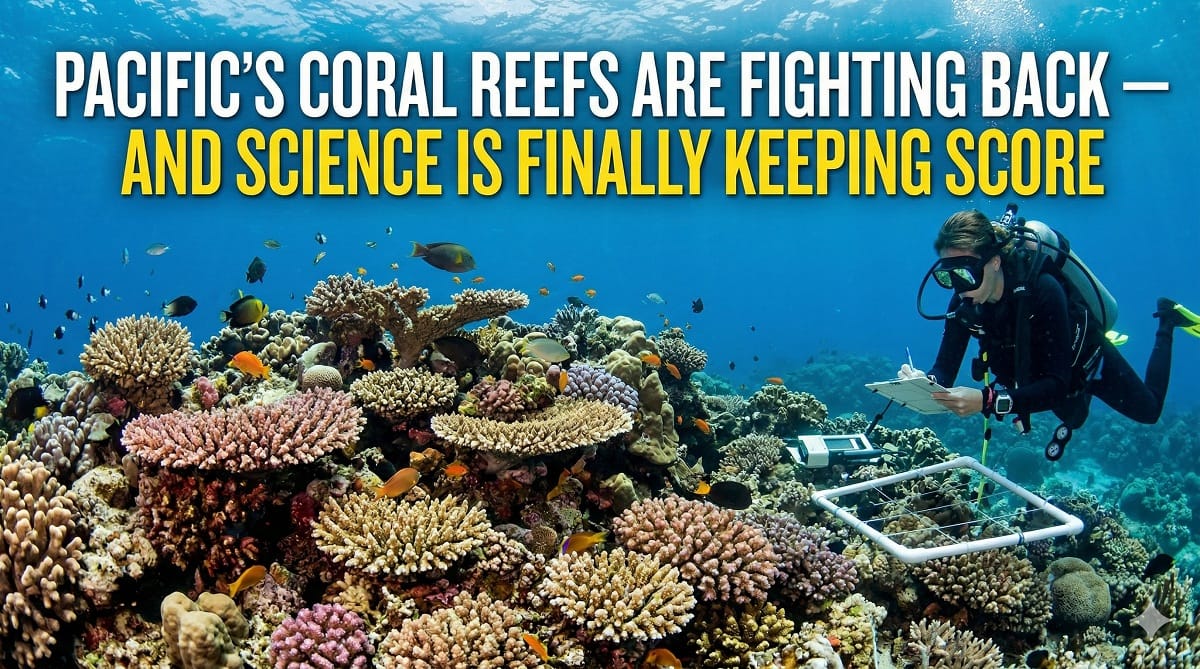
Landmark surveys, record-breaking monitoring expeditions, and AI-driven technology are painting a cautiously hopeful picture for Pacific reefs — but scientists warn the window for action is rapidly closing.
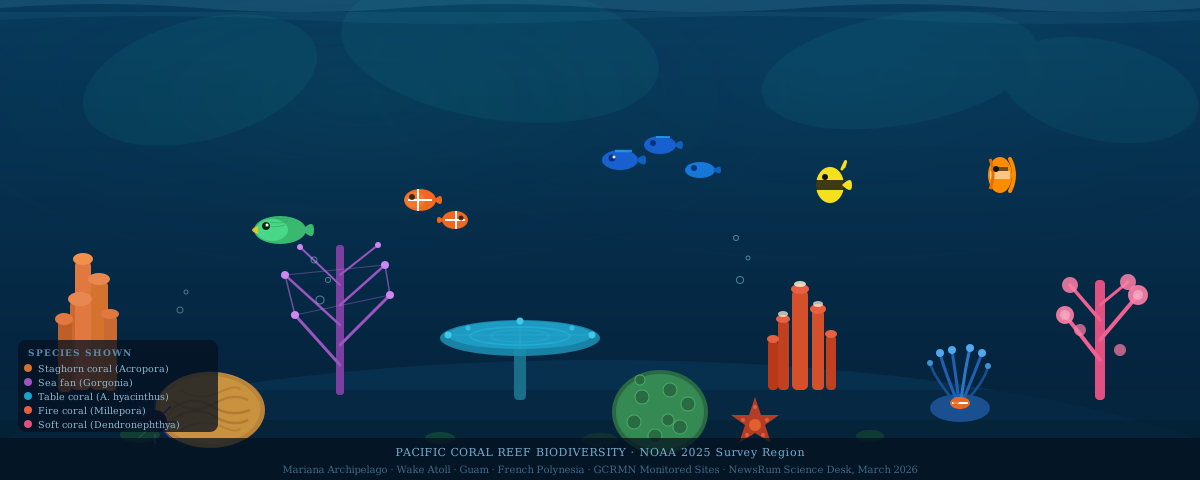
For decades, the story of the world’s coral reefs has been largely one of loss — bleaching, acidification, warming seas, and the slow retreat of one of Earth’s most biodiverse ecosystems. But in a remarkable shift driven by record-breaking surveys, cutting-edge AI monitoring, and a network of 600-plus scientists spanning 120 countries, a more nuanced — and, in key places, more hopeful — narrative is emerging from the Pacific.
The Pacific’s coral reefs, home to roughly 26% of the world’s reef systems, are proving more tenacious than many predicted. The latest data from the Global Coral Reef Monitoring Network (GCRMN), NOAA Fisheries, and the Coral Reef Alliance paints a picture that is simultaneously alarming and galvanizing — one where science, technology, and international cooperation are finally meeting the scale of the threat.
NOAA Shatters Its Own Records in the Mariana Archipelago
In 2025, NOAA’s Pacific Islands Fisheries Science Center completed what scientists are calling the most productive single-year coral reef survey ever conducted in the Mariana Archipelago. Aboard the NOAA Ship Oscar Elton Sette, researchers traveled more than 3,500 kilometers from Honolulu to Wake Atoll — a distance roughly equivalent to crossing the continental United States — before working their way through Guam and the Commonwealth of the Northern Mariana Islands over a three-month expedition.
The mission broke previous records for the number of fish and benthic surveys completed in a single year for the region, including a first-ever survey of Guguan Island, completed despite challenging conditions from Tropical Storm Sewat. By deploying new image-analysis software to process coral photographs after returning from the field, researchers freed up precious dive time for additional fish counts and coral imagery — maximising every minute underwater.
“These surveys are like a routine health check-up for the ocean — scientists assess fish populations, coral health, and ocean chemistry to detect changes and identify potential threats.”
— NOAA National Coral Reef Monitoring Program
The resulting dataset feeds into decades-long monitoring efforts that give resource managers and policymakers the evidence they need to act. In 2026, the team has already announced plans to extend the survey to American Sāmoa, Howland, Baker, and Jarvis Islands, as well as Palmyra Atoll and Kingman Reef.
The GCRMN Pacific Report: Resilience, But Not Without Warning
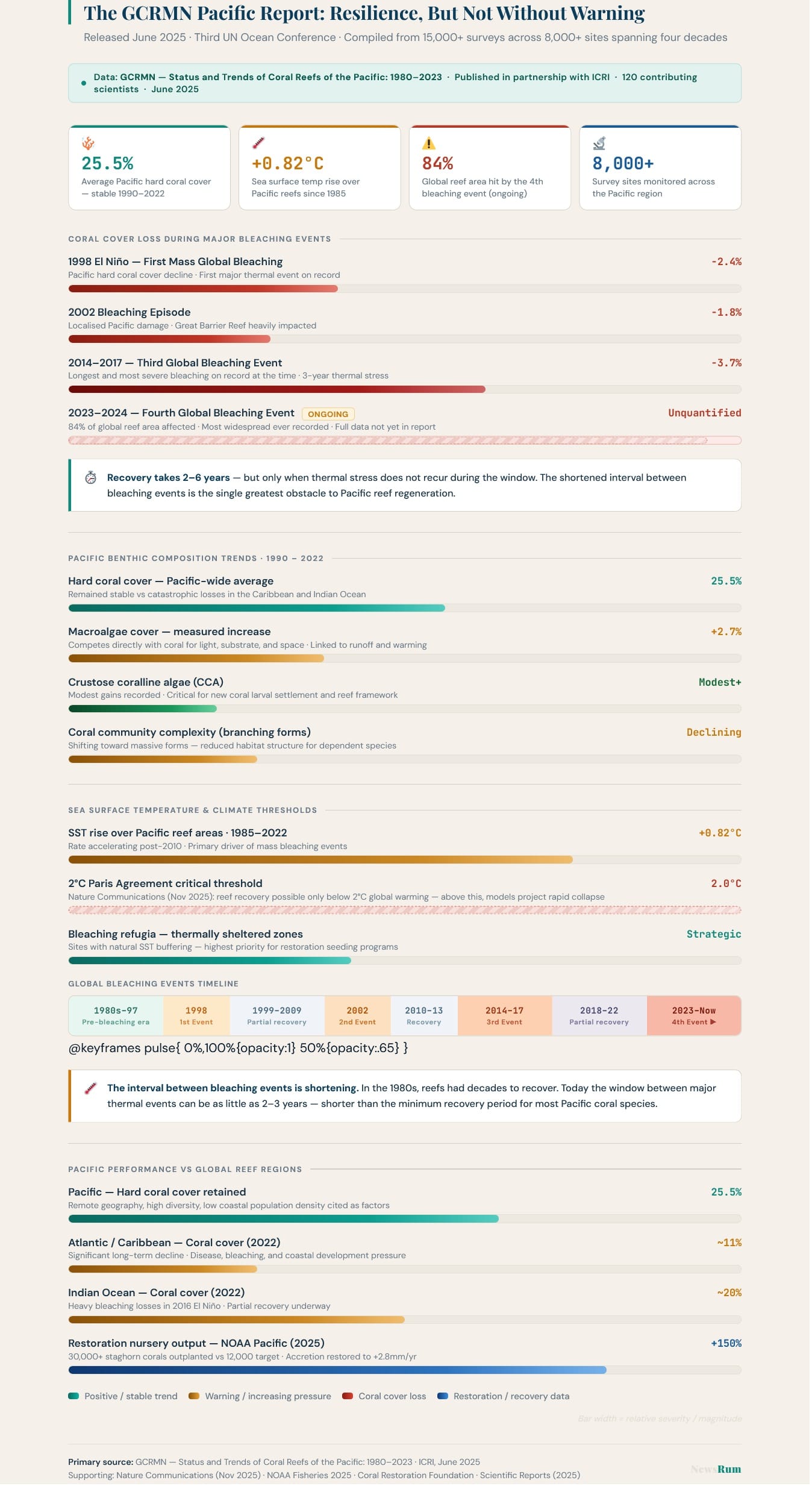
Released in June 2025 at the Third United Nations Ocean Conference, the Status and Trends of Coral Reefs of the Pacific: 1980–2023 — compiled by the GCRMN and ICRI — is the most comprehensive reef assessment ever produced for the region. Drawn from over 15,000 surveys across more than 8,000 sites spanning nearly four decades, the report offers a granular, honest look at where the Pacific’s reefs stand.
The headline finding surprised many: the Pacific’s average hard coral cover remained relatively stable at 25.5% from 1990 to 2022, even as reef systems in the Caribbean and Indian Ocean suffered catastrophic declines. Scientists attribute this resilience to the region’s vast and remote geography, high ecological diversity, and comparatively low coastal human populations.
| Metric | Change | Significance |
|---|---|---|
| Hard coral cover (1990–2022) | Stable at 25.5% | Outperforms Caribbean & Indian Ocean |
| Macroalgae cover | +2.7% | Competes with coral for space & light |
| Sea surface temperature (1985–2022) | +0.82°C | Primary driver of bleaching events |
| Recovery time post-bleaching | 2–6 years | Only possible with stable temperatures |
“We can only survive as the Pacific Islands Region if our coral reef ecosystems continue to protect and provide, as they have for generations.”
— Sefanaia Nawadra, Director General, Secretariat of the Pacific Regional Environment Programme (SPREP)
AI and Technology: The New Frontier of Reef Monitoring
One of the most significant developments reshaping coral reef science is the integration of artificial intelligence into monitoring programs. The Australian Institute of Marine Science (AIMS) has deployed its ReefCloud AI platform across Pacific community-based management programs, enabling reef monitors to deliver findings to governments within 48 hours of surveys — compared to weeks or months under traditional methods.
NOAA’s survey teams are similarly harnessing machine learning to interpret the millions of underwater coral images captured each year. According to NOAA data, only 1–2% of underwater reef images have historically been analysed by expert scientists — a bottleneck that AI is beginning to dissolve. Automated image segmentation systems trained on Pacific reef ecosystems can now identify coral species, measure coverage, and flag bleaching with a precision that would take a human team months to replicate.
Restoration Science: What’s Working, and What’s Not
On the restoration front, results are genuinely encouraging. NOAA-supported nursery programs have produced staghorn and elkhorn corals at rates that far exceed initial targets: one project generated more than 30,000 branching corals against an initial goal of 12,000, and critically, survivors demonstrated resilience even after recovering from bleaching events.
Research published in Scientific Reports in 2025 found that within just 2–6 years of outplanting rapidly-growing Acropora cervicornis (staghorn coral), restoration efforts had increased reef accretion potential from net erosion to a positive 2.8 mm per year — and driven significant increases in structural complexity.
“Every coral planted is a hedge against permanent ecosystem collapse. Even partial recovery buys time for marine life to adapt.”
— Coral Restoration Foundation, 2025 Tipping Point Report
The 2°C Threshold: A Line in the Coral Sand
A November 2025 study in Nature Communications, simulating eco-evolutionary dynamics across 3,800 reefs of the Great Barrier Reef, found that reef recovery this century is scientifically possible — but only if global warming is held below 2°C, allowing corals’ own thermal adaptation to keep pace with rising temperatures. Above that threshold, the models project a rapid cascade toward reef collapse.
Bleaching refugia — areas naturally sheltered from the worst of marine heatwaves — are emerging as strategic priorities. These zones tend to support greater thermal diversity among coral populations, making them the most likely candidates to serve as recovery nurseries for surrounding reefs if ocean conditions stabilise.
“Alarming increases in sea surface temperatures across many places in the Pacific indicate that safeguarding coral reef ecosystems is more urgent than ever.”
— Dr. Stacy Jupiter, Executive Director, WCS Global Marine Program
Tourism, Community, and the Economy of Hope
The Reef-World Foundation’s 2024–2025 Impact Report documented a 26% reduction in environmental threats from dive and snorkel operators committed to the UN Environment Programme’s Green Fins Code of Conduct — a sign that industry-led stewardship can deliver measurable reef benefits at scale. Six Green Fins members achieved a perfect zero-risk score, an industry first.
The economics of reef restoration are also increasingly compelling. Every dollar invested in reef restoration generates an estimated $1.40 to $1.60 in local economic activity through fisheries, eco-tourism, and coastal protection — making reef conservation not just an environmental imperative, but a sound economic investment for Pacific Island nations.
What Comes Next: 2026 and Beyond
The GCRMN’s seventh global “Status of Coral Reefs of the World” report is due for release in 2026, and will incorporate data from more than 120 countries and 90,000-plus surveys. It will be the most comprehensive snapshot of global reef health ever compiled — and the first to fully capture the impact of the Fourth Global Bleaching Event.
The science is converging on a clear message: the Pacific’s reefs are remarkable survivors, but they cannot survive without global action on emissions, local action on water quality, and sustained investment in monitoring and restoration. The record-breaking surveys, the AI breakthroughs, the community-based programs — all of it buys time. What happens with that time is a political and civilisational choice.
Sources: NOAA Fisheries (2025 Mariana Archipelago Survey) · GCRMN Pacific Report 2025 (ICRI) · Coral Reef Alliance 2025 Impact Report · Nature Communications (2°C Threshold Study, Nov 2025) · Scientific Reports (Reef Accretion Study, 2025) · Coral Restoration Foundation Tipping Point Report 2025 · AIMS ReefCloud AI Program · Reef-World / Green Fins Impact Report 2024–25