

By NewsRum Editorial Desk · October 5, 2023 · 8 min read · Sources: 5 verified
★ First commercial pilot lines launched in early 2026 by Motech and Oxford PV
★ Combines perovskite’s light absorption with silicon’s stability in tandem design
★ Could slash residential solar costs by 40% through higher energy yield
Perovskite’s Lab-to-Fab Leap: The 30% Solar Breakthrough That’s Finally Hitting Factories
For decades, the efficiency ceiling for silicon solar panels seemed stubbornly fixed around 22%. Then came the “miracle material” – perovskite – promising to turbocharge solar energy. While lab prototypes boasted astonishing 25%+ efficiencies, translating this lab success into mass-produced panels proved devilishly difficult. Now, that revolution is finally leaving the research bench and entering the factory floor, with the first commercial-scale pilot lines for perovskite-silicon tandem cells launching in early 2026. This isn’t just incremental improvement; it’s a potential paradigm shift that could slash costs and dramatically boost energy production from every rooftop.
How Tandem Cells Outperform Single-Junction Panels
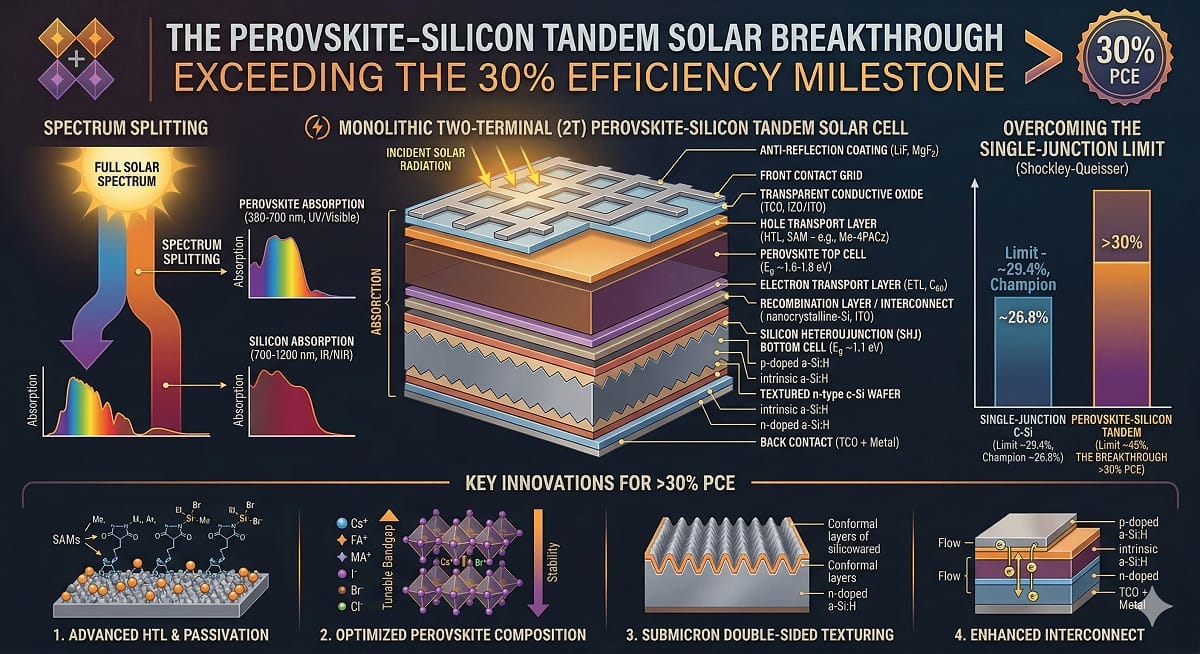
Imagine a solar panel as a layered sandwich. Traditional silicon panels are like a single slice of bread – they absorb most sunlight but miss some wavelengths. Perovskite-silicon tandem cells stack two slices: a thin perovskite layer on top and a silicon layer below. The perovskite layer excels at capturing high-energy blue light, while the silicon layer efficiently converts the remaining red and infrared light. This dual-layer approach captures a much broader spectrum of sunlight, theoretically pushing efficiencies beyond 30% – a leap that could make solar power significantly more competitive with fossil fuels.
Overcoming the Perovskite Challenge
The journey from lab breakthrough to factory production has been fraught with challenges. Perovskite materials, while incredibly efficient, are notoriously unstable, prone to degradation from moisture, heat, and light. Manufacturing them at scale required solving complex encapsulation and deposition techniques. Companies like Oxford PV (a spin-off from Oxford University) and Motech Industries have invested heavily in developing robust manufacturing processes and protective coatings. Their 2026 pilot lines represent the culmination of years of intense R&D, proving that perovskite can be integrated reliably into existing solar manufacturing workflows.
Turbocharging the Solar Market
The implications are profound. Higher efficiency means more electricity from the same roof space, crucial for urban areas with limited area. It also means fewer panels needed for the same output, reducing material costs and land use. For homeowners, this translates to potentially higher energy savings and faster payback periods. For investors, the perovskite-silicon tandem market is seen as a high-growth opportunity, with analysts predicting rapid cost declines similar to the early days of silicon panels. The entry of major manufacturers like Motech signals a move from niche research to mainstream adoption.
“Perovskite-silicon tandems represent the most significant efficiency leap in solar since the invention of the silicon cell itself. We’re moving from lab curiosities to real-world power plants.”
— Dr. Chris Case, Chief Technology Officer, Oxford PV
| Technology | Efficiency Range | Cost Trend | Key Advantage |
|---|---|---|---|
| Traditional Silicon | 15-22% | Declining slowly | Proven reliability |
| Perovskite-Silicon Tandem | 25-30%+ (Emerging) | Projected steep decline | High efficiency, space savings |
- Perovskite-silicon tandem solar cells promise efficiencies exceeding 30%, a major leap from the current 22% silicon standard.
- Commercial-scale pilot production lines launched in early 2026 by Oxford PV and Motech Industries.
- The tandem design combines perovskite’s light absorption with silicon’s stability for higher energy capture.
- Potential 40% cost reduction and significant space savings for residential and commercial installations.
- Overcoming perovskite stability and manufacturing challenges is key to mainstream adoption.
Frequently Asked Questions
Q: How do perovskite-silicon tandem cells actually work?
A: They use two layers: a thin perovskite layer on top that captures high-energy blue light, and a silicon layer underneath that captures the remaining red and infrared light. This dual-layer approach captures a much wider spectrum of sunlight than a single silicon layer, leading to higher efficiency.
Q: When will these panels be available to homeowners?
A: While commercial pilot lines launched in 2026, widespread residential availability will take time. Early adopters might see them in premium installations within 2-3 years, with broader market penetration following.
Q: Are perovskite cells stable enough for long-term use?
A: Stability has been a major hurdle. Companies like Oxford PV are developing advanced encapsulation and manufacturing techniques to ensure durability comparable to traditional silicon panels, which typically last 25+ years.
Q: Will tandem panels be more expensive initially?
A: While the initial cost per watt might be higher than standard panels, the significantly higher efficiency means fewer panels are needed for the same power output, potentially leading to lower overall system costs and faster payback periods.