

Published: February 18, 2026 | Category: Green Energy & Climate Wins | Reading time: 6 min
The UK Wind Farms Slashed Electricity Prices
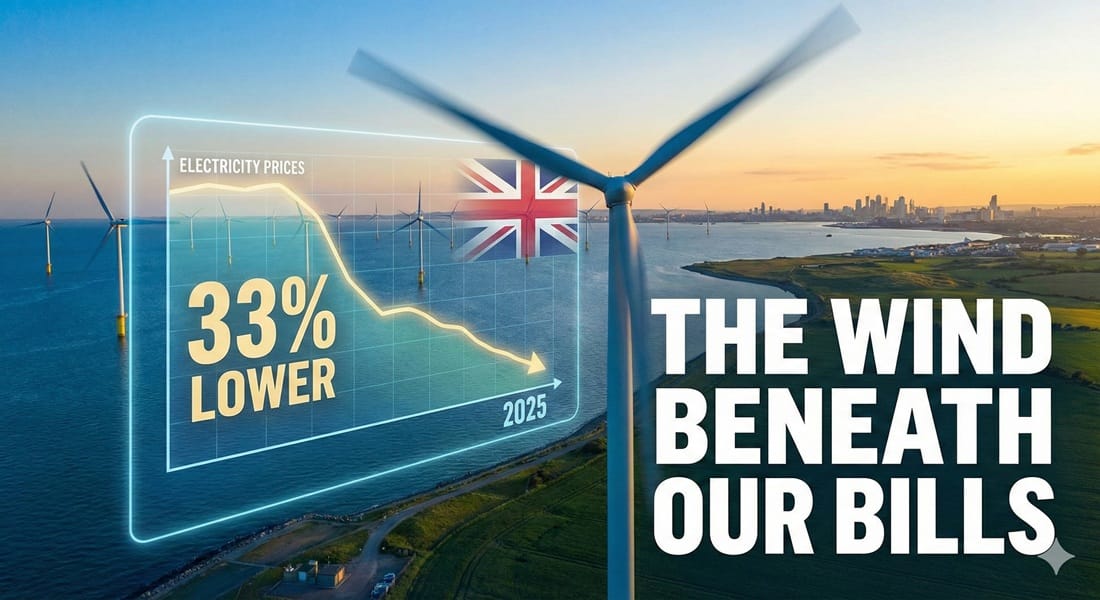
Buried quietly in the fine print of your energy bill is a saving you never knew you had — one delivered not by a government scheme or a price cap, but by the wind itself. New analysis reveals that Britain’s fleet of wind farms cut the wholesale price of electricity by almost a third in 2025, saving households and businesses tens of billions of pounds and proving, once and for all, that the clean energy transition is paying off in cold, hard cash.
The Numbers That Should Be on Every Kitchen Table
According to analysis by the Energy and Climate Intelligence Unit (ECIU), the average price of electricity traded on day-ahead markets in 2025 was around £83 per megawatt-hour (MWh) — but could have reached as high as £121 per MWh were it not for Britain’s windfarms limiting the role of gas power plants in setting prices. That saving of around £38 per MWh amounts to a price cut of 31% — almost a third.
To put that in plain English: if Britain had no wind farms, every unit of electricity you used last year would have cost nearly half as much again. And this isn’t a one-off spike of good luck. These results build on savings of 25% in 2024, and are part of a longer-term trend of rising savings as Britain’s growing fleet of wind farms pushes gas power plants off the system.
Why Does Wind Power Reduce Your Electricity Bill?
The UK’s electricity market works by pricing every unit of power at the cost of the most expensive generator running at any given moment — and for decades, that has almost always been a gas power station. As gas prices soared during the global energy crisis, household bills followed in lockstep.
Wind power breaks that link. When turbines spin, they flood the grid with electricity that costs nothing to generate — no fuel to import, no commodity price to track. This “crowds out” the more expensive gas plants, forcing the overall market price downward. It’s known in energy economics as the “merit order effect,” and its impact is now unmistakably visible in the data.
Wind power is “diluting the link between power prices and gas prices,” the ECIU found — with electricity costs determined by gas around 85% of the time, down from around 100% in 2020. That’s a seismic structural shift happening quietly, right above our heads.
A Record Auction Sets the Stage for Even Lower Bills
The wind story doesn’t end in 2025 — it’s accelerating. In January 2026, the UK government announced results from its Allocation Round 7 (AR7) renewables auction — the largest in British history. The UK secured a record 8.4 gigawatts (GW) of new offshore wind capacity in the first part of the auction, followed by a further 7.4GW of solar, onshore wind, and tidal power in the second. Combined, AR7 is the UK’s single-largest auction round, with its 14.7GW of new renewable capacity being 50% larger than the previous record set by AR6 in 2024.
What does that mean for bills? Had these new wind farms been operating over the last year, gas power generation could have been a third lower, cutting day-ahead wholesale electricity prices by up to £11 per MWh — down to £72/MWh. Taken together with existing wind savings, had Britain deployed no wind power over recent decades and relied more on gas instead, power prices could have been up to two-thirds higher in 2025.
The prices for onshore wind and solar in the latest auction, at £72/MWh and £65/MWh respectively, are comfortably below recent wholesale power prices, which averaged £81/MWh in 2025 — meaning the new projects will actively cut costs for UK electricity consumers, according to multiple analysts.
Energy Independence: No Country Can Tax the Wind
Perhaps the most underappreciated dimension of the UK wind boom is what it represents geopolitically: freedom from fossil fuel dependence on foreign states.
As energy experts have noted, more drilling in the North Sea won’t make any real difference to the gas bills British homes pay, because it’s international markets — driven by the actions of actors like Putin and Trump — that dictate the price. Renewable wind power, by contrast, lowered the wholesale power price by around a third in 2025, squeezing more expensive gas power off the system. Every wind turbine built means the UK is less dependent on gas imports and less vulnerable to volatility in the gas price. “We don’t have to import wind or sunshine.”
Wind and solar projects secured in the AR7 auction are set to cut the UK’s gas demand and limit gas imports by over 80 TWh per year — more than three times as much as the extra gas that might be produced in 2030 if new drilling licences were issued.
This is energy security written in megawatts, not in diplomatic agreements.
25 Years of Offshore Wind: A £30 Billion Gift to Britain
The current moment has deep roots. The UK’s offshore wind industry celebrates its 25th anniversary in 2025-26, and the cumulative savings are staggering. Since the late 2000s, cumulative generation from UK offshore wind has totalled over 400 terawatt-hours (TWh) — electricity that otherwise would likely have been provided by a mixture of gas and coal. UK offshore wind farms currently produce almost 50TWh of electricity per year, representing 17% of total UK generation.
The avoided spending on imported fuels? Over £30 billion — and counting.
The Jobs Wind: 55,000 and Rising
The benefits aren’t just on energy bills. Britain’s wind industry is now a major engine of employment, particularly in coastal and post-industrial communities that need it most. According to the Wind Industry Skills Intelligence Report 2025, offshore wind employment has risen from just over 32,000 in 2023 to nearly 40,000 — a 24% increase — while over 15,000 people now work in onshore wind. Combined, the total UK wind energy workforce exceeds 55,000 jobs.
Looking ahead to 2030, offshore wind alone could support between 74,000 and 95,000 jobs, with onshore wind employment expected to exceed 17,500. Jobs in wind, nuclear, and electricity networks all advertise average salaries of over £50,000 — well above the UK average of £37,000 — and are spread across coastal and post-industrial communities.
This is the green jobs dividend: well-paid, skilled, and rooted in communities that the old economy left behind.
What Experts Are Saying
“With the rollercoaster of gas prices over the past few years having hit British industry hard, and households still carrying debt from the gas crisis, this is a reminder that more renewables means more stability.” — Jess Ralston, Energy Analyst, ECIU
“By backing solar and onshore wind at scale, we’re driving bills down for good and protecting families, businesses, and our country from the fossil fuel rollercoaster controlled by petrostates and dictators.” — UK Government Minister on AR7a auction results, via Carbon Brief
“These investments ultimately strengthen the UK’s position against volatile gas markets. If the past few years have shown us anything, it’s that remaining tied to international energy markets comes with consequences.” — Lucy Dolton, Renewable Generation Lead, Cornwall Insight
The Bigger Picture: A Trend That’s Only Accelerating
By the end of 2025, renewables were projected to constitute nearly half of the UK’s entire energy supply — and in May 2025, zero-carbon sources (wind, solar, nuclear, and hydro) supplied 57% of Britain’s electricity, a significant 12 percentage point increase from May 2024.
The momentum is undeniable. Each new turbine that comes online tilts the balance further away from the volatile, import-dependent, petro-state-influenced fossil fuel market, and further toward homegrown, weather-powered, price-stable clean electricity.
Key Takeaways
✅ UK wind farms cut wholesale electricity prices by ~31% in 2025 — saving approximately £38/MWh compared to a no-wind scenario.
✅ Without any wind power, electricity prices in 2025 could have been up to two-thirds higher.
✅ The UK’s record-breaking AR7 auction secured 14.7GW of new renewable capacity — the largest ever — set to reduce bills further.
✅ The wind industry now employs over 55,000 people in the UK, with salaries averaging well above the national wage.
✅ Wind farms have saved Britain over £30 billion in avoided fossil fuel imports over 25 years.
The Bottom Line
The clean energy transition was once talked about as a future aspiration — a long-term investment that might, someday, pay dividends. That day has arrived. Britain’s wind farms are not just good for the planet; they are, right now, one of the most powerful forces keeping energy affordable for millions of households and businesses across the country.
The wind doesn’t send an invoice. It doesn’t negotiate with dictators. It doesn’t spike when a pipeline is sabotaged. It just blows — and the savings blow right into your pocket.
Sources: Energy and Climate Intelligence Unit (ECIU) | Carbon Brief | RenewableUK | UK Government Clean Energy Jobs Plan | E&E News / POLITICO