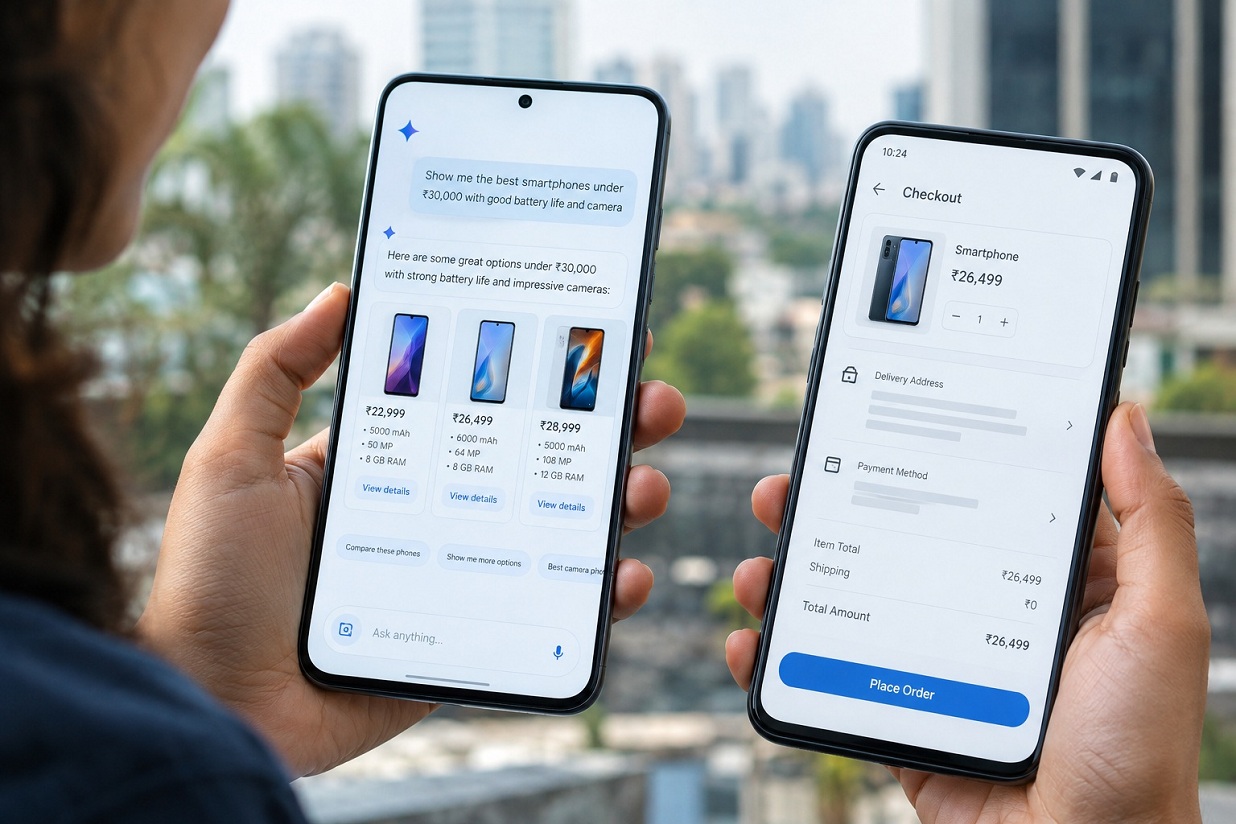


Google is testing a “Buy” button for selected Flipkart products inside Gemini and Google’s AI Mode in India, according to reporting published this week.
The experiment is currently limited to some users and a small selection of products, including smartphones, electronics and mobile accessories. For people included in the test, tapping the button opens a Flipkart-branded checkout flow without requiring them to leave the AI interface. Other users continue to see ordinary Flipkart product listings without the direct purchase option.
The development is significant because it moves Google’s AI shopping strategy another step beyond finding and comparing products. Gemini has already become a shopping discovery tool; the latest test explores what happens when the AI interface also becomes a direct route toward a purchase.
Google has not announced a full public launch. A Google spokesperson told TechCrunch that the company is “always testing new features and experiences” to help people discover and connect with businesses, while declining to provide further details about the Flipkart experiment.
What Happened
The reported test is taking place in India, with selected Flipkart listings appearing inside both the Gemini app and Google’s AI Mode in Search.
For users who have access to the experiment, eligible products display a Buy option. Selecting it leads into a Flipkart checkout experience within the AI environment.
The test is not available to everyone.
TechCrunch reported that the initial group is limited to some users and that the products covered include smartphones, electronics and mobile accessories. Users outside the experiment continue to receive normal product listings without the purchase button.
The distinction is important. Google has not announced that every Gemini user in India can now buy Flipkart products directly through the AI assistant.
Instead, the company is testing a specific shopping flow before any wider availability.
TechCrunch reported that Google plans to expand the experience more broadly later in October, ahead of India’s festive shopping season. That timeline comes from a person familiar with the test rather than from a formal Google product announcement.
The Numbers Behind the Story
There are relatively few hard numbers attached to the current Flipkart experiment because Google has not disclosed the size of the test.
The important figures and facts currently confirmed or reported are:
- India: The test is being conducted with Indian users.
- Two Google AI surfaces: Gemini and AI Mode in Google Search.
- Limited users: The experiment is not available to all users.
- Selected products: Early coverage includes smartphones, electronics and mobile accessories.
- One retailer with direct buying: Flipkart listings in the reported test display the Buy option.
- Later October: A broader rollout has been reported as a planned next step, although Google has not publicly announced a firm launch date.
Google’s broader shopping infrastructure is considerably larger.
In April, Google said its Shopping Graph contained more than 50 billion product listings, with about 2 billion product updates each hour. The company said Gemini shopping in India could already provide product listings, comparison tables, prices and places to buy.
Those figures describe Google’s wider shopping system, not the size of the Flipkart test.
That distinction matters because it would be misleading to suggest that billions of products are suddenly available for direct AI checkout.
From Product Search to Purchase
The bigger change is happening in the role Google wants AI to play.
Until recently, an AI shopping assistant could largely be described as a research tool. A shopper might ask Gemini to compare phones, identify the best options within a budget or explain differences between products.
Google has been steadily expanding that model.
In April, Google said Gemini in India could provide shoppable product listings, comparisons, prices and places to buy directly within the conversation. Its AI Mode in Search could also organize information such as prices, reviews and inventory.
The Flipkart test adds another step.
Instead of:
Ask → Compare → Click retailer → Buy
the experience moves toward:
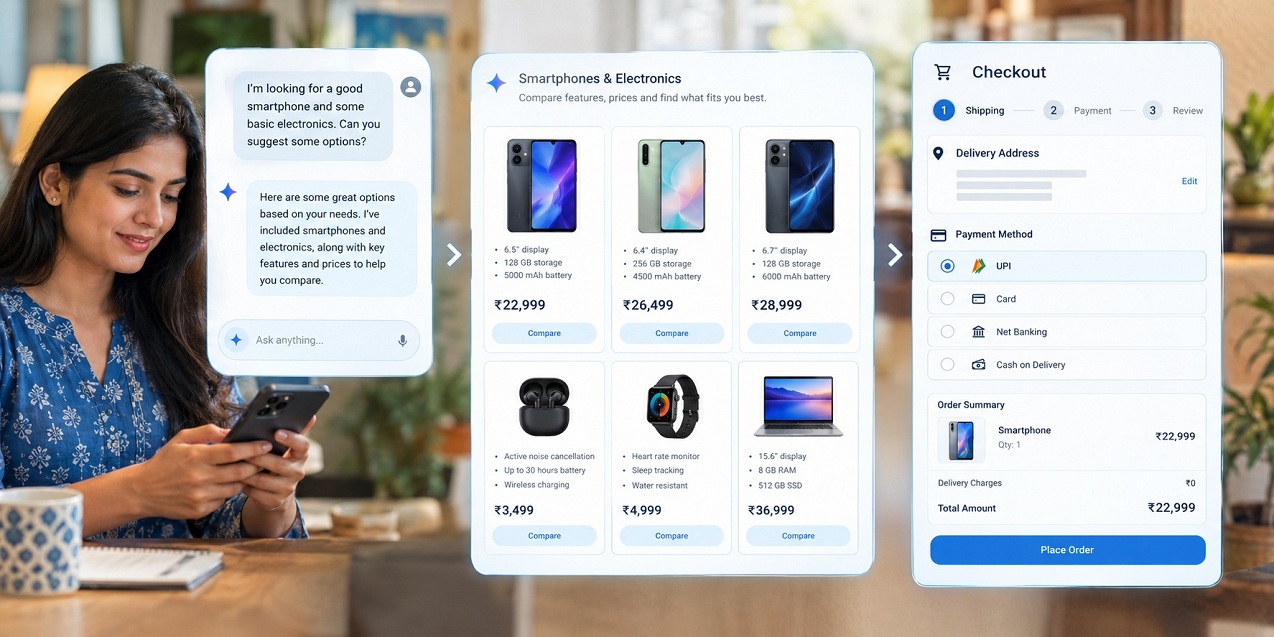
Ask → Compare → Buy
That may sound like a small interface change, but it reflects a much broader shift in how technology companies are approaching online commerce.
The AI assistant is becoming the layer between the shopper and the retailer.
Google’s Agentic Commerce Strategy
The Flipkart experiment did not emerge in isolation.
In January, Google introduced the Universal Commerce Protocol (UCP), an open-source standard intended to allow AI agents, businesses and payment providers to communicate across the shopping journey.
Google said UCP was designed to support commerce from product discovery through purchase and was developed with industry participants including Shopify, Etsy, Wayfair, Target and Walmart. Flipkart was among the companies listed as endorsing the broader ecosystem.
Google subsequently expanded the idea.
At Google I/O in May, the company introduced Universal Cart, designed to allow shoppers to add products while browsing across Google services including Search and Gemini. Google said UCP could support checkout through Google Pay for some merchants or transfer shoppers to a retailer’s site to complete purchases.
The current Flipkart test appears somewhat different.
TechCrunch reported that the checkout shown in the experiment is Flipkart-branded, rather than the Google-hosted checkout experience Google had previously demonstrated. The technology behind this particular implementation has not been publicly explained.
That means the exact relationship between the Flipkart test and UCP should not be assumed without further technical disclosure from Google or Flipkart.
Why India Matters
India is an important testing ground for Google’s AI shopping ambitions.
The country has a large and increasingly digital consumer market, while Flipkart and Amazon are major competitors in online retail.
The timing is also notable.
India’s festive shopping period is one of the most important periods of the year for online retailers, with major marketplaces typically competing heavily for shoppers.
A reported expansion of the Gemini-Flipkart experience in October would place the feature close to that period. However, the October timing remains a reported plan rather than a confirmed public launch date from Google.
Google’s April announcement also shows that it has been actively building AI shopping capabilities specifically for Indian users, including shopping experiences in Gemini and AI Mode and support for English and Hindi in the Gemini shopping experience.
So the Flipkart test is part of an existing direction rather than a completely new Google initiative.
What About Amazon?
One detail of the test is particularly noteworthy.
TechCrunch reported that Amazon products could appear alongside Flipkart products in Google’s AI shopping results, but the Amazon listings did not have the same direct purchase option in the experience it observed.
That does not establish that Amazon will never receive a similar capability.
It simply describes the current test.
Google’s commerce strategy is intended to work across multiple retailers, and its UCP initiative is explicitly designed as an open standard rather than a system built for one marketplace.
The present Flipkart test therefore should be viewed as an early implementation rather than evidence that Google has chosen Flipkart as its exclusive AI-commerce partner.
What It Could Mean for Shoppers
For consumers, the attraction is straightforward: fewer steps between discovering a product and buying it.
A shopper researching a smartphone, for example, could ask Gemini for options, compare products and then move directly into a retailer’s checkout process.
That could make AI-assisted shopping more convenient, particularly for people who already use conversational search rather than traditional keyword searches.
But convenience also raises practical questions.
Shoppers will want to know whether product information, prices, stock availability and discounts are current. They may also want clarity about who is responsible for the transaction, returns, refunds and customer support.
In the reported test, the checkout is Flipkart-branded, which makes the retailer’s role visible. But Google has not publicly explained all of the technical and commercial arrangements behind the experiment.
The Affiliate Marketing Question
There is another group watching this development closely: publishers, creators and affiliate marketers.
Traditional affiliate commerce often works by sending a shopper from a review, comparison or deal page to a retailer through a tracked referral link.
AI-assisted shopping changes that path.
If a consumer asks Gemini which phone to buy and can move directly from the AI’s recommendation to a retailer’s checkout, there may be fewer opportunities for the shopper to visit the websites that traditionally sit between search and purchase.
That does not mean affiliate marketing will disappear.
It does mean the economics of product discovery could change if AI interfaces become an increasingly important place where consumers make purchasing decisions.
Google and Flipkart have not publicly disclosed how affiliate attribution or commissions would work for this specific experiment, so any conclusions about its financial impact would be premature.
Google’s Relationship With Flipkart
There is also an existing business relationship between the two companies.
TechCrunch reported that Google invested approximately $350 million in Flipkart in 2024, taking a minority stake in the company as part of a funding round led by Walmart.
That relationship provides useful context when examining the new shopping test.
However, the existence of the investment does not by itself establish why the current test was selected, how the commercial arrangement works or whether Flipkart will receive preferential treatment in Google’s broader AI shopping strategy.
Those details have not been publicly disclosed.
What Comes Next
The immediate question is whether Google expands the experiment beyond its current limited group of users and products.
TechCrunch reported that a wider rollout could come later in October, ahead of India’s festive shopping season. That remains a reported timetable rather than a confirmed Google launch announcement.
There are several other questions to watch.
Will more product categories become eligible?
Will other major Indian retailers receive similar Buy buttons?
Will Google eventually host more of the transaction itself through its commerce infrastructure?
And will AI-generated recommendations become a meaningful gateway to online purchases rather than simply another way of fiing products?
Google’s existing Universal Commerce Protocol and Universal Cart projects suggest that the company is building toward a shopping system in which AI can participate in more stages of the transaction.
The Flipkart test provides an early, visible example of what that strategy could look like in practice.
Conclusion
Google’s Flipkart experiment is still small.
It is being tested with selected users, covers a limited range of products and has not been announced as a general feature for every Gemini user in India.
But the direction is clear from Google’s broader product development.
Gemini has moved from answering questions to helping people discover products. Google’s AI Mode can compare prices, reviews and shopping information. Universal Commerce Protocol is designed to connect AI agents with retailers and payment systems. And now, in a limited Indian test, selected Flipkart listings can take users directly toward checkout.
The important question is therefore not simply whether Google has added a Buy button.
It is whether AI assistants are beginning to become a new layer of online commerce — one where consumers increasingly ask an AI what to buy, compare the options through conversation and then move directly into a retailer’s transaction flow.
For Indian shoppers, the answer may become clearer when Google’s reported October expansion arrives.