Australia’s renewable-energy transition has just crossed a striking new threshold — and rooftop solar is at the heart of it.
For about 30 minutes around lunchtime on September 19, Australia’s National Electricity Market reached a milestone that would have sounded extraordinary only a few years ago: renewable energy supplied 80.4% of electricity generation.
The record was confirmed by the Australian Energy Market Operator (AEMO), with the moment coming as solar production surged across homes and large-scale projects while wind power supplied additional generation.
And there was one especially remarkable detail.
Rooftop solar alone accounted for 52% of generation at the peak.
That means the solar panels sitting on ordinary homes and businesses were collectively producing more electricity than all other individual generation sources at that moment. Grid-scale solar contributed another 16%, wind supplied 11%, and hydro added 1%. Coal accounted for 19%, while gas supplied 1%.
A record built from millions of rooftops
Australia’s renewable-energy story is no longer just about enormous solar farms or distant wind projects.
Increasingly, it is happening on suburban rooftops.
The September record shows just how powerful that distributed generation has become. Earlier reporting by The Independent noted that rooftop solar had already been responsible for nearly half of generation during the previous record-setting period on September 18. The following day, AEMO recorded the renewable share at 80.4%.
The broader trend is just as striking.
Renewables supplied an average 42.1% of the NEM during the June quarter of 2026, according to reporting based on AEMO figures — itself a quarterly record.
So the 80.4% moment was not an isolated story about one unusually sunny afternoon. It was an extreme snapshot of a much larger transformation already underway.
The batteries were working, too
There was another part of the story happening quietly behind the scenes.
When solar and wind production becomes extremely high, the challenge changes. The question is no longer simply how to generate enough electricity.
It becomes: What do you do with all the electricity when there is more renewable power available than the grid can immediately use?
That is where batteries and pumped hydro come in.
Analysis published by pv magazine Australia found that around 5.33 GW of flexible demand was absorbing surplus electricity during the record conditions, including about 4.46 GW going into batteries and roughly 880 MW into pumped hydro. At the same time, around 8.42 GW of available renewable generation was being curtailed.
In simple terms, Australia was producing so much renewable electricity that some of it had to be switched down — while batteries were simultaneously charging to capture part of the surplus.
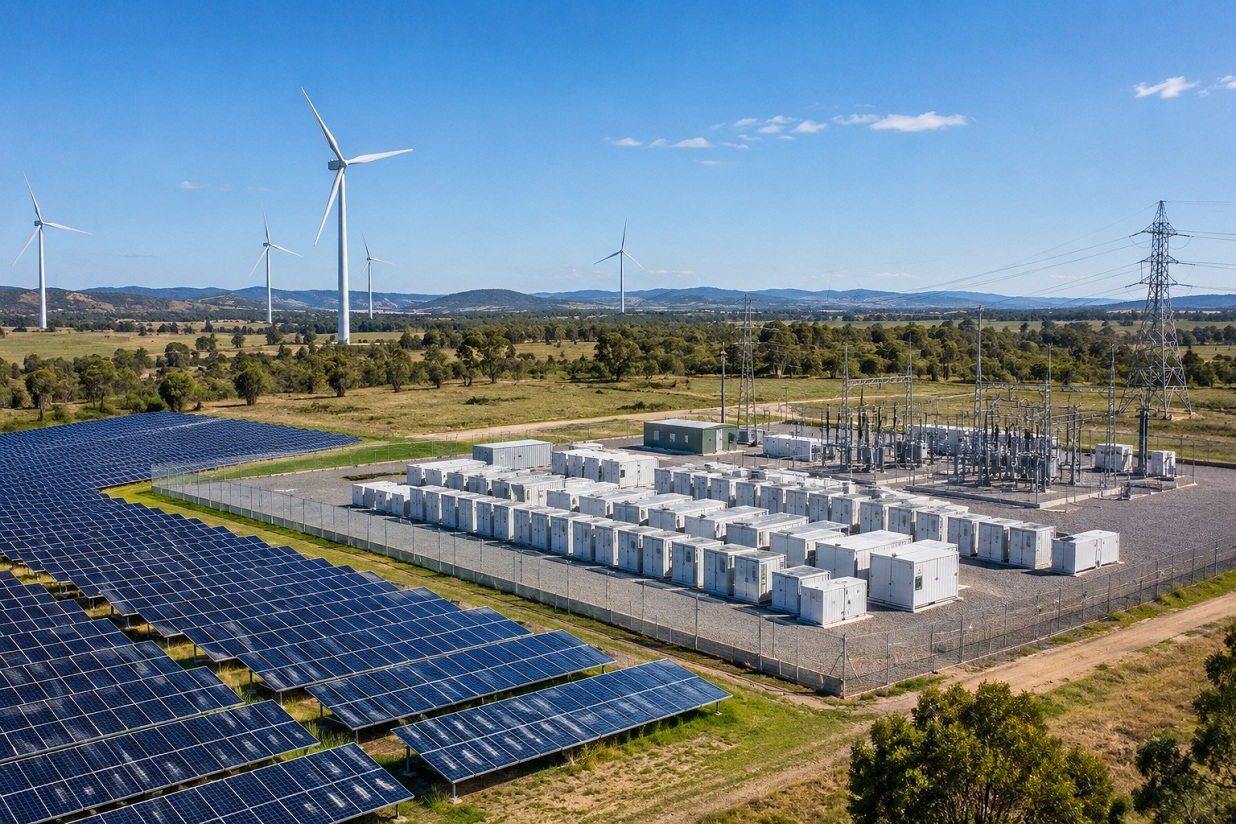
That is an important glimpse of what the future grid may look like: solar during the day, batteries absorbing excess generation, and stored electricity available when the sun goes down.
An 80% moment does not mean an 80% renewable day
There is an important qualification behind the headline.
The 80.4% figure was an instantaneous peak over roughly 30 minutes. It does not mean that 80.4% of Australia’s electricity came from renewables throughout the entire day.
That distinction matters.
Electricity systems have to balance supply and demand every second. Solar production rises during daylight and disappears after sunset. Wind output varies. Batteries have finite storage. Transmission lines can become congested.
That is why records like this are both exciting and technically challenging.
They demonstrate how much renewable generation the grid can accommodate — while also showing why storage, transmission, grid-forming technology and smarter demand management are becoming increasingly important.
The next milestone could arrive sooner than expected
The remarkable thing about the September record is how quickly previous records were overtaken.
Renewable generation reached roughly 79.5% on September 18, according to The Independent, only for AEMO’s 80.4% record to follow the next day.
pv magazine Australia also reported another series of records over the same weekend, including a new low for operational demand and record rooftop photovoltaic output.
That suggests the 80% milestone may not remain unusual for long as more rooftop solar, utility-scale renewable projects and batteries are added to the system.
There is still plenty of work ahead. Grid operators must manage periods when renewable production is extremely high as well as periods when solar and wind output is low. Transmission capacity and energy storage will become increasingly important as older fossil-fuel generators retire and the generation mix changes.
But for a few minutes on a sunny Saturday afternoon, Australia offered a striking preview of what a renewable-heavy electricity system can look like.
Solar panels on ordinary rooftops supplied more than half the grid. Wind and large solar farms added even more. Batteries absorbed surplus power. And renewable generation crossed the 80% mark for the first time.
It wasn’t an entire day powered by clean energy.
But it was a remarkable glimpse of where the electricity system is heading.