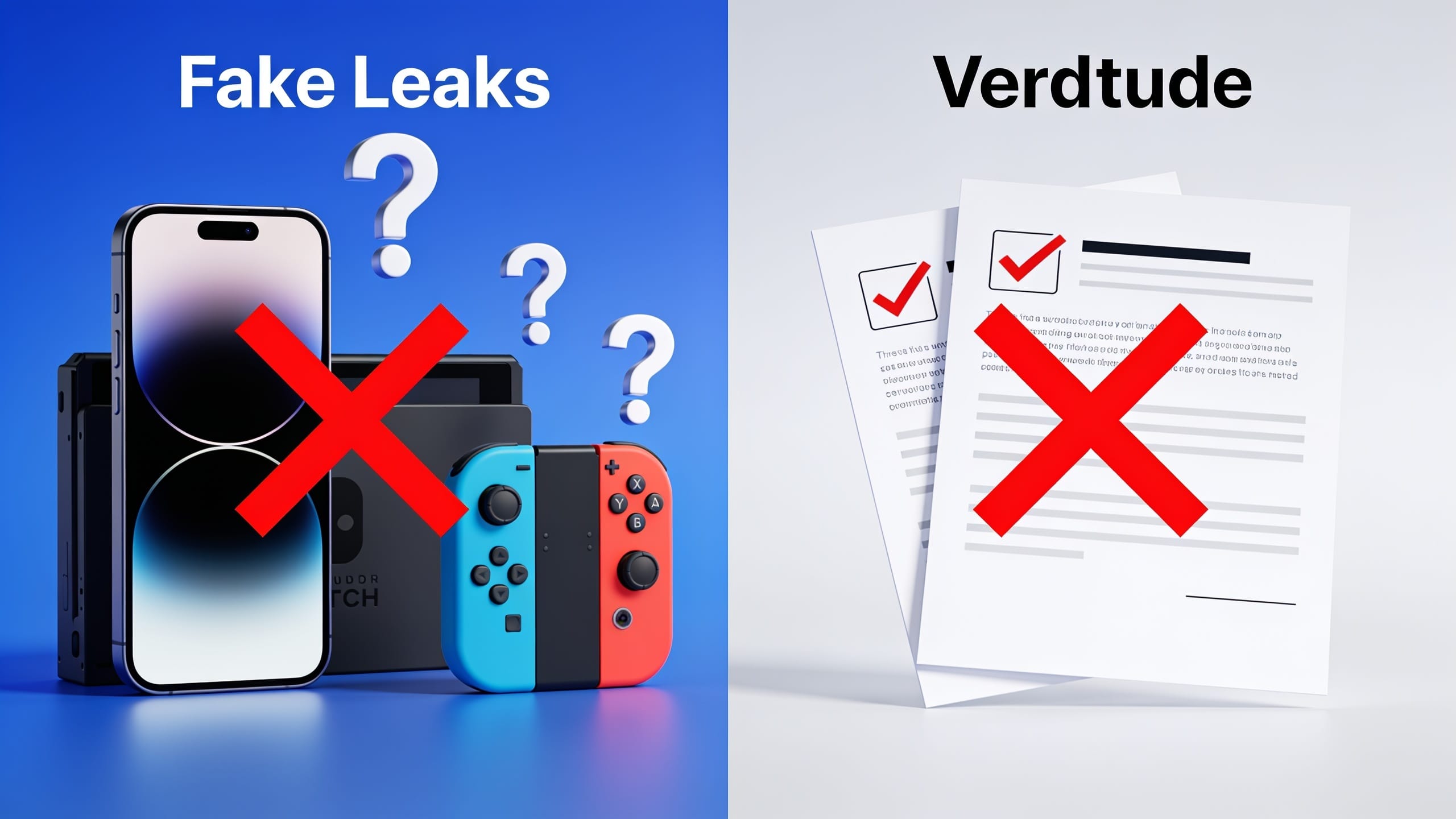


A “leaked” screenshot of some unreleased phone, or a “confirmed” spec sheet for a gaming console nobody’s seen yet, can pull hundreds of thousands of shares in a matter of hours. And a huge chunk of that stuff? Completely made up. Learning to spot fake tech leaks used to be a nerdy hobby. Now it’s basically a survival skill for anyone who follows tech, gaming, or entertainment online. So let’s get into what actually separates a real leak from a fabricated one, how to check a rumor before you smash that share button, and the red flags that show up over and over in the leaks that eventually get torn apart.
Table of Contents
- What Are Fake Tech Leaks, and Why Do They Spread So Fast?
- How to Actually Verify a Rumor Before You Share It
- The Dead Giveaways of a Fake Leak
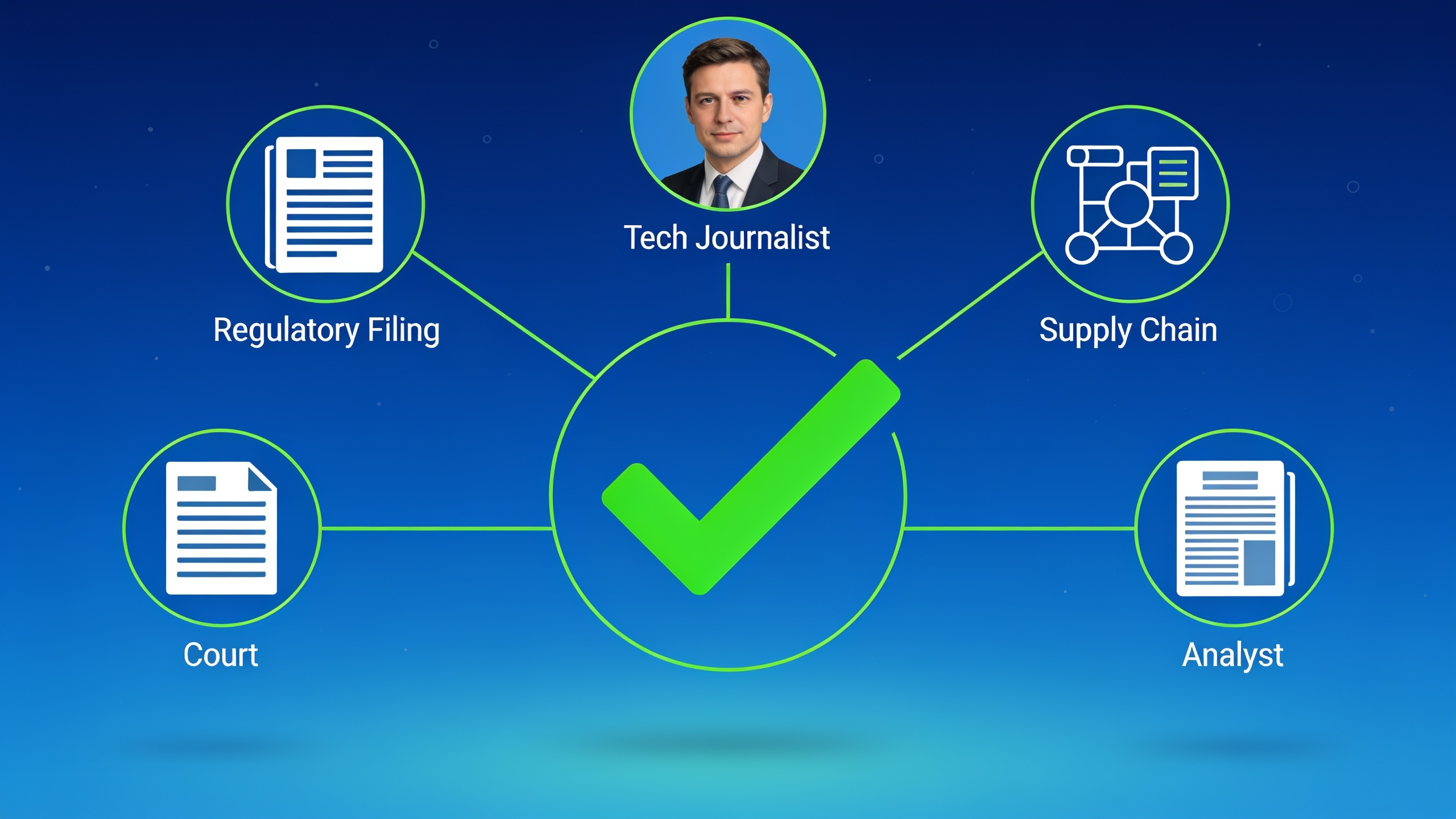
- So Where Do Real Leaks Come From?
- Red Flags vs. Green Flags: The Cheat Sheet
- When the Internet Got Completely Fooled
- Why This Keeps Happening Anyway
- FAQ
What Are Fake Tech Leaks, and Why Do They Spread So Fast?
Fake tech leaks are fabricated or wildly exaggerated claims about unreleased products, features, or corporate moves, dressed up as insider info but backed by absolutely nothing you can verify. They spread fast because they’re basically engineered to. Sometimes on purpose, sometimes by accident. Either way, they hit the exact buttons that make tech and gaming communities lose their minds: anticipation, tribalism, and that gnawing fear that everyone else is going to know before you do.
A fake leak usually starts life on a forum, a Discord server, or some anonymous account with a confident-but-vague line like “hearing from a source close to the matter…” And because nobody scrolling past can confirm or deny it in the first five minutes, the thing just… takes off. Aggregator accounts grab it, small blogs chasing traffic run with it, and before long a mainstream outlet is writing “rumors are swirling.” By the time anyone bothers to fact-check, the story’s already miles away from where it started. Compare that to a genuine leak, which is unauthorized but real information. An internal doc, a photo from the factory floor, a regulatory filing. Actual unreleased details, not vibes.
Why does the difference matter so much? Because the hook is identical in both cases. It’s the promise of forbidden knowledge, right now, before the crowd. That’s exactly why a fabricated leak about a phone, a console, a movie casting, whatever, can outperform verified news on shares and comments. At least until reality catches up.
How to Actually Verify a Rumor Before You Share It
The short version: trace the claim to where it started, check whether that source has ever been right before, and find at least one unrelated outlet backing it up before you treat it as real. Skip those steps and you become part of the problem, because every share adds a fake layer of legitimacy without adding a shred of evidence.
Trace it back to who said it first. Before you repeat anything, ask who actually said this, and what do they claim to know? A shocking amount of viral tech news is a summary of a summary of a summary. If a headline says “reports suggest,” go find the report. If there’s no original document, screenshot, or named person underneath it all, treat it as unverified. Not true-until-proven-false. Just unverified. Being repeated a thousand times isn’t evidence, it’s just noise at volume.
Check the track record. Some leakers and outlets have spent years being right more than they’re wrong. Others post ten things a day and never get called out when nine of them flop. So look at the history. Did their last handful of predictions actually land, or did they get quietly walked back? The console and phone-leak communities are honestly obsessive about keeping informal scorecards on well-known leakers, and that reputation is one of the fastest ways to gauge how much a new claim is worth.
Look for backup. One anonymous post is not confirmation, no matter how many juicy details it includes. Real leaks tend to get corroborated by something unrelated. A different leaker with no connection to the first, a court filing, a regulatory disclosure, an official statement that accidentally confirms part of it. If a rumor’s been floating around for days and not one credible source has matched any piece of it? That silence tells you something.
And read the actual document. When a “leak” is supposedly built on a screenshot or an internal slide, look at the image yourself instead of trusting somebody’s description of it. Fonts that don’t match the company’s style, weird formatting, watermarks that look slapped on, dates that don’t add up. Those are the tells. And if you can’t even see the original file, only a paraphrase of it? Dial your confidence way down.
The Dead Giveaways of a Fake Leak
Fabricated leaks tend to rhyme. Vague sourcing, suspiciously slick presentation, timing that just happens to line up with a competitor’s big announcement, and claims that are conveniently impossible to disprove in the moment. Learning to recognize the pattern in real time beats trying to fact-check every detail after it’s already gone viral.
The sourcing thing is the biggest one. “Sources say.” “Insiders confirm.” “According to leaked documents.” No named outlet, no named person, no document you can actually look at. Real leaks, even anonymous ones, usually come from an identifiable account or publication that’s putting its reputation on the line. When the sourcing is circular, one anonymous post citing another anonymous post citing a third, there’s often just… nothing underneath. All the way down.
Then there’s the too-perfect problem. Leaks that show up suspiciously close to a company’s own announcement, or that read like polished marketing copy instead of the messy fragments you’d expect from a real internal doc, are often either coordinated hype stunts or straight-up fakes riding the wave right before a reveal. Genuine internal leaks are almost always partial. A spec here, a code name there. Not a gorgeous, finished product page.
Watch the emotional temperature too. Fake leaks lean hard into outrage or hype or fear, because those feelings drive shares way faster than a neutral report. If a claim about a console price hike or a phone battery defect or a canceled feature is clearly engineered to make you furious or thrilled before you’ve confirmed a single word of it, treat that intensity as a warning, not proof.
Oh, and one more. Any leak built on a cropped screenshot, of a text, a Slack thread, a code repo, deserves a raised eyebrow until you see what’s around it. Cropping is the easiest way in the world to manufacture something convincing, because it hides the exact context that would give the game away.
So Where Do Real Leaks Come From?
Legit leaks tend to come from a pretty small set of recurring places: supply chain and manufacturing partners, regulatory filings, court documents, developer conference materials, and a handful of analysts and journalists with real relationships inside companies. Knowing these channels helps you judge whether a claim is even plausible based on where it supposedly came from.
Supply chain leaks happen because electronics companies lean on dozens of component makers and assemblers, and unreleased hardware passes through a lot of hands before it ever hits a shelf. Regulatory leaks come from public filings. A device popping up in a certification database, a trademark application that spills a product name months early. Analyst leaks come from people who cover supply chains for a living and have spent years building sources, which is why the same named analysts in the phone and PC world get cited by mainstream press again and again, even though technically none of it is official.
Not every source carries the same weight, though. It helps to think about leak credibility in tiers instead of a simple true-or-false switch.
| Source Type | Typical Reliability | How to Verify | Risk of Misinformation |
|---|---|---|---|
| Regulatory filings (FCC, trademark databases, certification bodies) | High — based on public documents | Check the filing directly on the government or agency database | Low |
| Established industry analysts with long track records | Generally high, but not infallible | Compare against their past prediction accuracy over several product cycles | Low to moderate |
| Named tech journalists at recognized outlets | Moderate to high, depends on outlet standards | Check if the outlet names sources or shows documents | Moderate |
| Anonymous forum or Discord leakers | Highly variable | Look for a documented history of confirmed leaks under the same handle | High |
| Random social media accounts with no history | Very low | Search for corroboration; check account creation date and posting pattern | Very high |
| AI-generated or auto-aggregated “news” sites | Very low | Check whether the site cites an identifiable primary source at all | Very high |
This tiered thinking is basically what separates a hobbyist who gets fooled every few months from someone who consistently filters signal from noise. And honestly it’s the same instinct you’d use for something totally ordinary, like hiring a contractor. You check reviews, licensing, a track record before you trust anyone’s claim about the quality of their work, the same way you’d dig into a company like Minneapolis House Painting before handing them a project instead of taking one glowing testimonial at face value. Verifying a leak runs on the exact same logic. Reputation and evidence beat confidence and polish every single time.
Red Flags vs. Green Flags: The Cheat Sheet
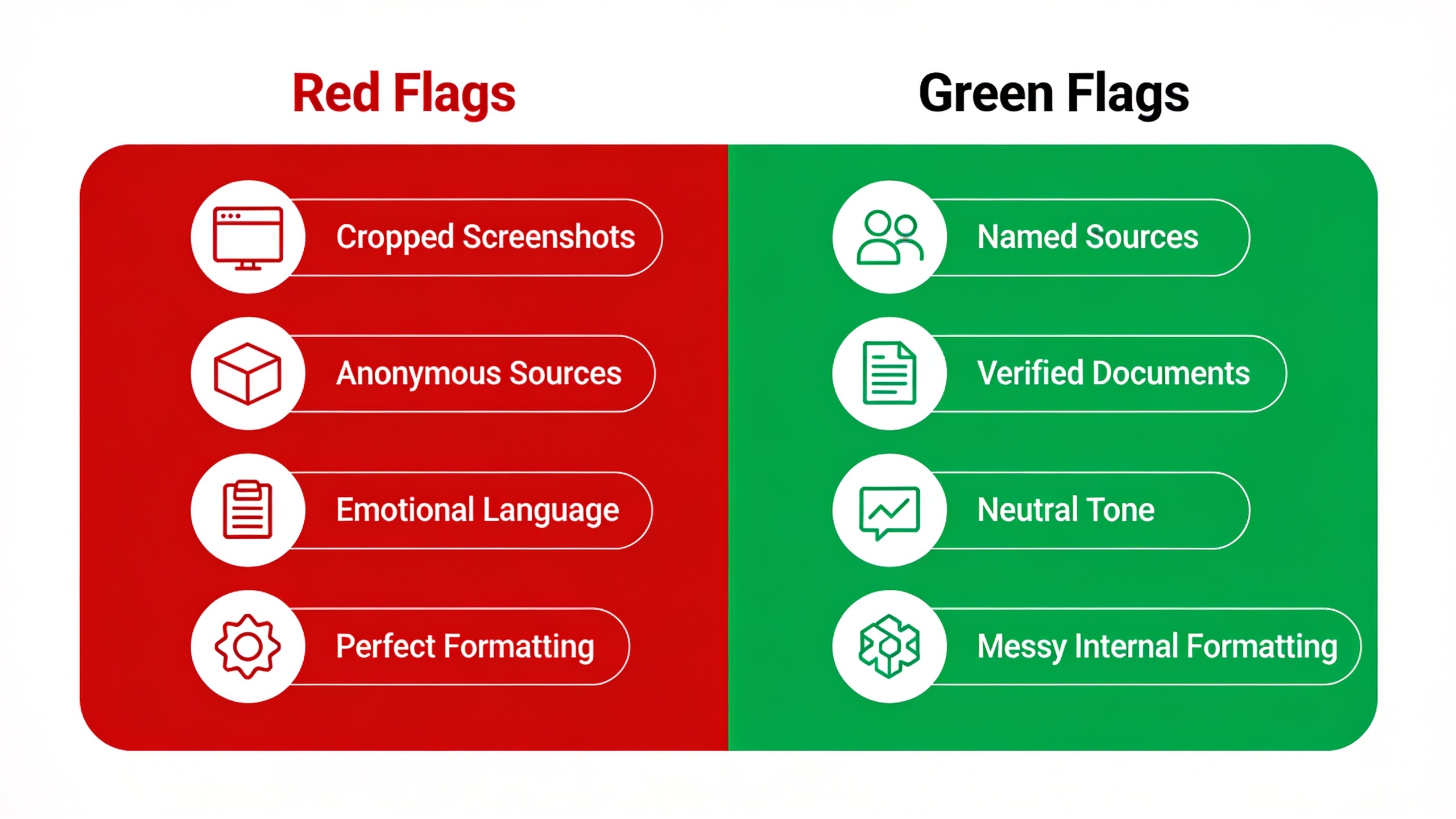
Judging a leak comes down to tallying red flags against green flags, not hunting for one magic clue. No single signal proves anything by itself. But the more red flags pile up, the more skeptical you should get.
Green flags: a named or consistently identifiable source with a real accuracy history, backup from at least one unrelated outlet, actual visible documents instead of paraphrased descriptions, and claims that are modest and partial rather than sweeping and complete. Red flags: anonymous or circular sourcing, screenshots ripped from their context, framing designed to make you feel something right now, timing that conveniently beats a competitor to the punch, and claims that are just too comprehensive and too glossy to pass for a real internal leak.
Here’s a mental trick I like. Ask yourself: “If this turns out to be garbage next week, will anyone actually be held accountable for spreading it?” If the answer’s no, because the source is anonymous or untraceable or already deleted the post, that alone should drop your confidence through the floor. Doesn’t matter how thrilling the claim is.
When the Internet Got Completely Fooled
The gaming and tech world churns out viral rumors that briefly convince enormous audiences and then fall apart the second anyone looks closely. Fake console specs, invented casting news, fabricated feature lists, they’ve all done the rounds. What ties these disasters together is a formula: an emotionally irresistible premise (a franchise people adore, a device everyone’s dying for) bolted onto sourcing that literally nobody traced back to the origin until it had already been reposted ten thousand times.
Which is worth remembering, because not every rumor is fake. Some genuinely land, and being able to tell them apart is the whole point of developing a critical eye in the first place. If you want to see the flip side, where speculation actually turned out to be right, it’s worth reading through stuff like Top 10 Gaming Rumors That Actually Came True in 2024. It’s a good look at what legit leaks tend to look like in hindsight. Partial, weirdly specific, and confirmed from a few unrelated directions rather than dropping as one perfectly wrapped reveal.
The takeaway from both the fakes and the real ones is the same, and it’s kind of a nice rule of thumb: credible info tends to build up slowly, from multiple independent angles. Fake leaks tend to arrive as a single, complete, emotionally charged package that’s practically begging you to share it before you look too hard.
Why This Keeps Happening Anyway
Fake tech leaks keep spreading because social media rewards speed and emotion over accuracy, and by the time something gets debunked, the correction reaches maybe a tenth of the people the original did. It’s not a tech-specific problem, the same thing plagues entertainment and health and lifestyle rumors, but tech and gaming are especially exposed because the communities are so passionate and move so fast.
Platforms are built to surface whatever gets an immediate reaction. And a dramatic unverified leak always, always beats a careful “hey, this isn’t confirmed yet” post on engagement. Aggregators and small blogs have a money reason to publish first instead of publish right, because traffic pays for speed, not correctness. And since corrections basically never go viral the way the lie did, a debunked leak can keep circulating in screenshots for months, quietly fooling everyone who stumbles onto it fresh.
Knowing all this won’t make you bulletproof. You’ll still get fooled once in a while, everyone does. But it makes you a lot less likely to be one of the thousands amplifying something that thirty seconds of tracing would’ve flagged as shaky.
FAQ
How do I tell if a leak is fake in just a couple minutes?
Trace it to the original source, not the account that shoved it in front of you. If you can’t find a named person, a specific document, or an outlet with a real track record within a minute or two of digging, treat it as unverified. Spreading fast isn’t the same as being true.
Are leaks from big-name tech journalists always reliable?
Nope. Even established journalists get burned by bad sources sometimes. Outlets with actual editorial standards are usually more careful about naming or describing sourcing and issuing corrections when they blow it, but reliability is really about one person’s or outlet’s track record across a lot of stories, not the assumption that any publication is infallible.
Why do fake leaks often look more convincing than real ones?
Because they’re built for shareability. Fakes are usually more polished, more complete, and more emotionally satisfying than a genuine fragment of leaked info. Real internal stuff is messy and half-finished. So if a “leak” reads like a finished marketing page, that should make you more suspicious, not less.
Should I just ignore anonymous leakers entirely?
No, and that’d actually cost you real information. Some anonymous accounts have built genuinely solid track records over years of nailing product details. The trick is checking whether that specific handle has a documented history of being right, rather than writing off anonymity as automatically disqualifying.
Fastest way to verify a rumor before I share it?
Search the claim next to words like “debunked” or “confirmed” to see if someone’s already done the fact-checking for you. Check whether at least one unrelated outlet has backed up any part of it. And glance at the original source’s past accuracy. If none of that pans out in a few minutes, just… wait. Nothing bad happens if you’re a little late.
Spotting fake leaks isn’t about turning into a cynic who sneers at every rumor. Plenty of leaks turn out to be true, and that anticipation is a big part of why following this stuff is fun in the first place. It’s really about building one small habit: trace the claim, check the track record, wait for independent backup before you treat a rumor as fact. That tiny pause, done consistently, is usually all it takes to tell the leaks worth trusting from the ones built purely to go viral.