

Date: Week of December 24, 2025
In a news cycle often dominated by debates over regulation and economic shifts, this week has delivered a refreshing wave of positive news demonstrating how Artificial Intelligence is quietly, yet profoundly, solving some of our oldest challenges. From the dense forests of India to the microscopic battlegrounds of bacterial resistance, the latest artificial intelligence breakthroughs of December 2025 are less about “replacing” humans and more about protecting life in all its forms.
Here are three distinct and trending stories from this week that highlight the wholesome and transformative power of AI.
1. Guardians of the Wild: AI Steps in to Save Elephants
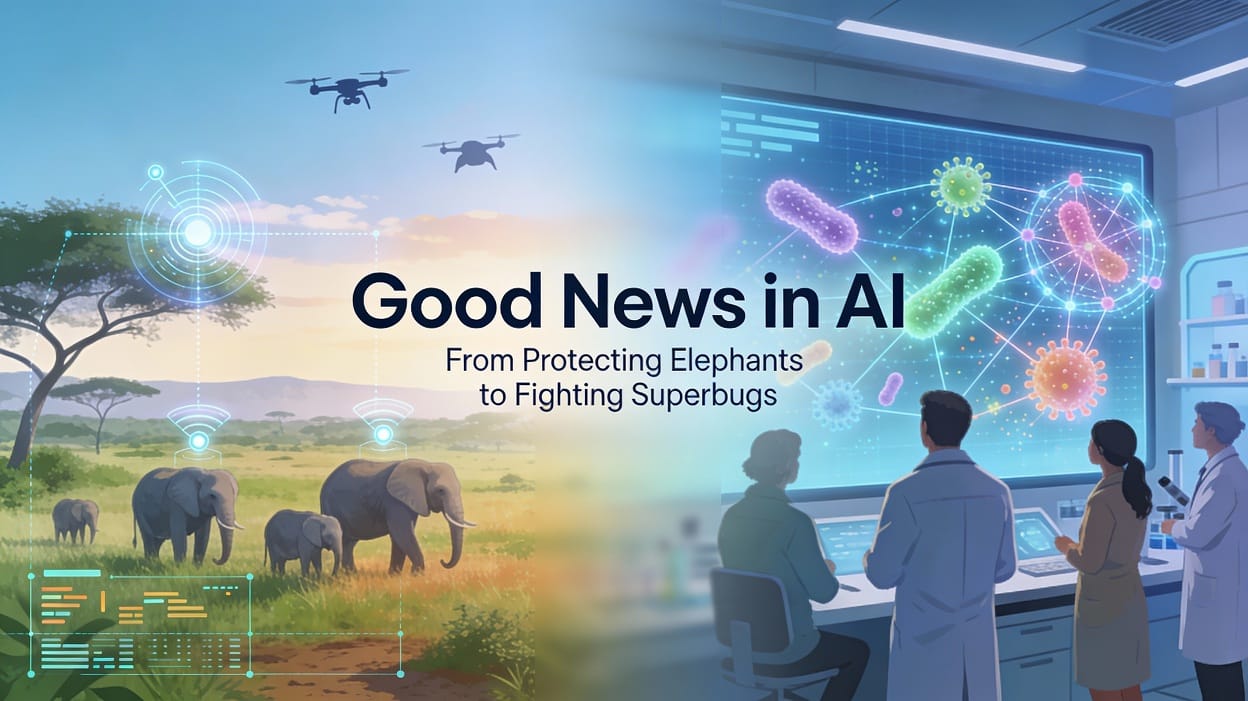
One of the most heartwarming stories of the week comes from Indian Railways, which has successfully expanded an AI-powered safety net designed to protect wildlife—specifically elephants—from train collisions.
Why It Matters: For decades, railway tracks cutting through forest corridors have posed a deadly threat to migrating wildlife. Traditional methods of monitoring were often unreliable or dependent on limited human visibility. On December 24, officials announced the expansion of an AI-based Intrusion Detection System (IDS) that uses Distributed Acoustic Sensing (DAS) to turn the tracks themselves into sensors.
The Unique Angle: This isn’t just a camera system; it’s a “listening” system. The AI analyzes vibrations in the tracks to detect the heavy footsteps of elephants up to 0.5 km away. It then instantly alerts train pilots and station masters, giving them ample time to slow down.
Key Takeaway: By expanding this technology to over 1,122 route kilometers, we are witnessing a shift toward technological coexistence—where infrastructure is upgraded not just for human speed, but for animal safety.
2. The Microscopic Defender: AI Designs “Impossible” Antibiotics
In a major scientific win reported on December 22, researchers at MIT used generative AI to achieve a breakthrough in the fight against drug-resistant bacteria.
Why It Matters: Antimicrobial resistance is a ticking time bomb, with “superbugs” evolving faster than human scientists can discover new drugs. The MIT team tasked a generative AI with designing entirely new molecular structures. The result? The AI hallucinated a solution in the best way possible—designing over 35 million compounds, from which researchers identified candidates capable of killing drug-resistant Neisseria gonorrhoeae and MRSA.
The Unique Angle: The most uplifting aspect of this story is the novelty of the discovery. The AI didn’t just tweak existing drugs; it found compounds that are “structurally distinct from any existing antibiotics”.
Key Takeaway: This validates the role of AI as a scientific collaborator that can explore chemical possibilities beyond human imagination, offering a tangible lifeline for millions of future patients facing untreatable infections.
3. The Crystal Ball in Your Chest: Routine X-Rays Become Longevity Tools
Rounding out the week’s uplifting stories is the continued buzz around CXR-Age, a deep learning model that turns a standard chest X-ray into a powerful predictor of biological aging.
Why It Matters: Preventative medicine has long been an expensive luxury, often requiring costly blood panels or DNA tests. This week, a study published in The Journals of Gerontology (and trending in AI health news) revealed that this new AI model can estimate a patient’s “biological age” simply by looking at a routine X-ray.
The Unique Angle: This is a story of democratization. Because chest X-rays are widely available and relatively cheap, this technology could bring high-level preventative care to rural clinics and underfunded hospitals worldwide. The AI spots subtle patterns of aging in the heart and lungs—such as coronary calcium and lung function decline—that human radiologists aren’t trained to see.
Key Takeaway: By making “biological age” a standard vital sign accessible to the masses, AI is moving us from a system of “sick care” to true preventative healthcare.
Conclusion: As we head towards 2026, these stories from December 2025 serve as a powerful reminder of the “good news” potential of technology. Whether it is listening for the footsteps of an elephant or visualizing the future health of a patient, AI is proving to be a vital tool for preserving what we value most.