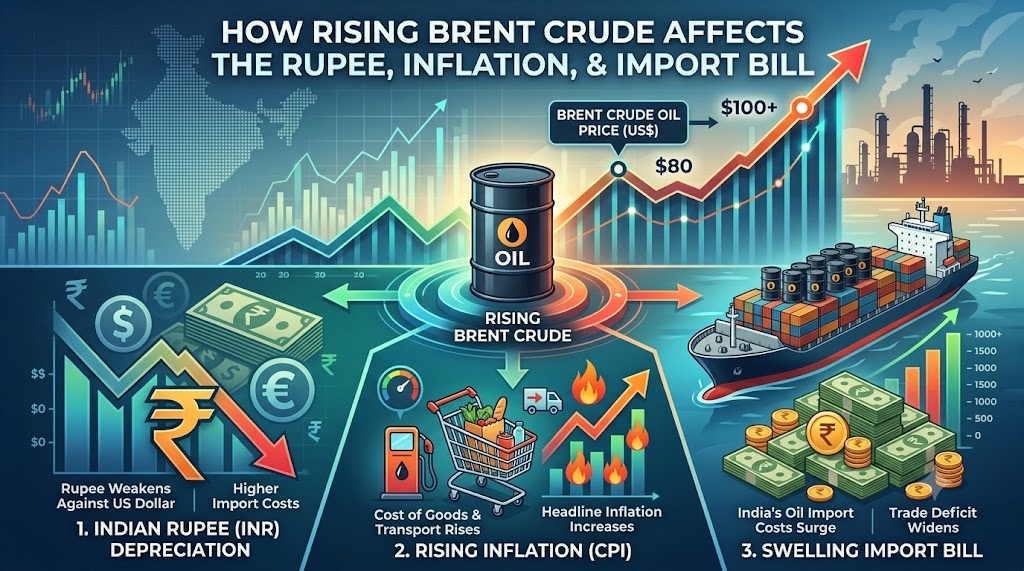


A sharp rise in global crude prices can put pressure on India’s external finances and household budgets. The scale of the impact depends on how long oil stays elevated, the rupee’s exchange rate and how much of the cost is passed on to consumers.
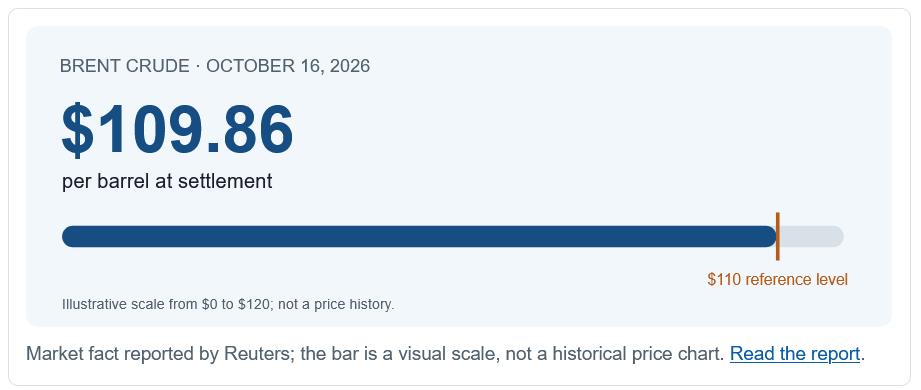
Brent crude settled at $109.86 a barrel on October 16, 2026, according to a Reuters report syndicated by MarketScreener. The reported settlement was up $3.94, or about 3.7%, on the day and was the highest close since May 19. That is a meaningful market signal for a country that imports most of the crude oil it consumes—but one day’s price does not, by itself, determine India’s final import bill or retail fuel prices.

What the October 16 price means
The reported $109.86 close provides a snapshot of the international market. Reuters attributed the market’s movement to investor assessment of possible US sanctions on a so-called shadow fleet and broader supply risks. Market prices can change quickly as traders reassess supply, demand, geopolitics and inventories.
Why India is exposed
India relies heavily on imported crude. A PPAC-based industry summary put import dependence at approximately 88.7% in FY2025–26, with imports of about 245.8 million tonnes. The exact cost impact of a price move depends on the price actually paid for India’s imported basket and the volume purchased.
Data reported for April–August 2026 put India’s crude import bill at about $74.8 billion, compared with $50.4 billion in the same period a year earlier. The reported value rose by around 48.4%, while volumes were slightly lower at approximately 100.7 million tonnes. This comparison covers five months and should not be interpreted as the effect of the October 16 Brent close alone.
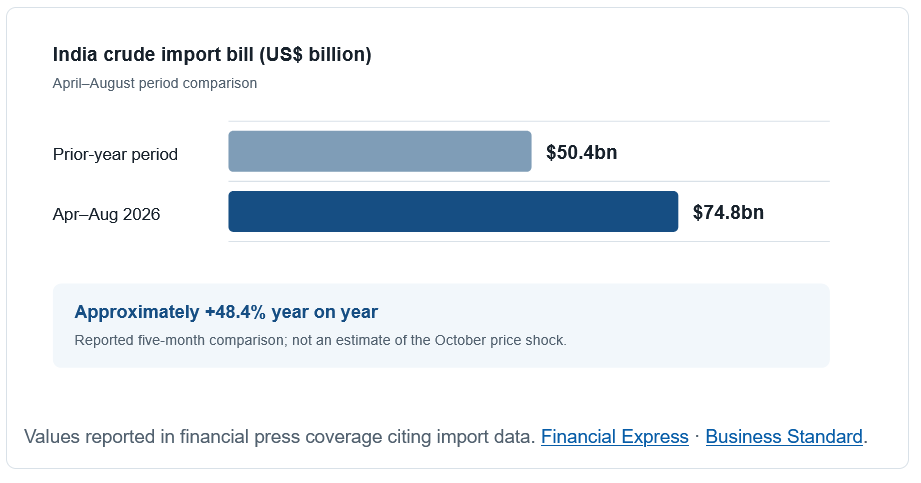
Values reported in financial press coverage citing import data. Financial Express · Business Standard.
How a sustained price rise could affect the import bill
A useful way to understand the exposure is to calculate the cost of a hypothetical increase that lasts for a full year. Using an illustrative crude import volume of 4.94 million barrels per day, every sustained $1-per-barrel increase would add roughly $1.80 billion a year before accounting for changes in volumes, discounts, freight, product mix or exchange rates.
For example, a sustained $10-per-barrel increase would imply about $18.0 billion in additional annual gross crude costs. At an illustrative exchange rate of ₹94.96 per US dollar, that is approximately ₹1.71 lakh crore.
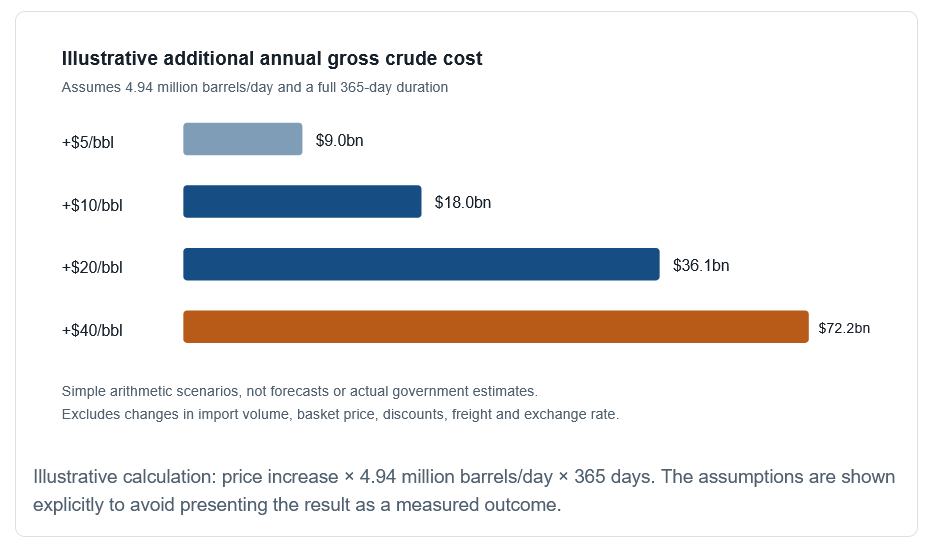
This is a sensitivity test, not a prediction. Brent is not identical to India’s crude basket, and a $10 change in Brent will not necessarily translate into a $10 change in every barrel India imports. The calculation also holds import volume constant and does not model government taxes, refinery economics, domestic fuel pricing or changes in demand.
What it could mean for the rupee
Oil is traded internationally in dollars. If India’s oil import costs rise and other factors remain unchanged, importers need more dollars, which can add demand in the foreign-exchange market. That can put pressure on the rupee and make dollar-denominated imports more expensive in rupee terms.
The rupee was reported at around ₹94.96 per US dollar on October 16, after recent weakness. The exchange rate is influenced by many forces—including capital flows, global dollar strength, trade flows and central-bank actions—so it would be misleading to attribute its movement to crude alone.
Reuters reported that the Reserve Bank of India took steps to support the currency, including a dollar window for major state-run oil companies. Such measures can smooth immediate demand in the spot market, but they do not eliminate the underlying cost of imported energy.
Inflation, transport and household budgets
Higher crude prices can reach consumers through petrol and diesel, aviation fuel, freight, petrochemicals and other petroleum-linked inputs. The timing and size of pass-through depend on taxes, pricing decisions, inventories, competition and whether oil marketing companies absorb some of the increase.
India’s provisional consumer-price inflation rate was reported at 5.54% year on year in September 2026, with food inflation at 7.74%, according to the Ministry of Statistics and Programme Implementation. Those figures describe the inflation backdrop before any full, sustained pass-through from the October oil move; they do not measure an oil-driven inflation increase.
- Transport and logistics: Diesel is a major operating cost for trucking and freight. If costs are passed through, goods can become more expensive.
- Aviation: Jet fuel can affect airline costs, fares and profitability.
- Agriculture: Diesel-powered irrigation and transport may face higher costs, although the effect varies by region and season.
- Manufacturing: Chemicals, plastics, paints, packaging and other oil-linked inputs may become more expensive.
- Households: Direct fuel costs and indirect increases in transport or goods prices can squeeze disposable income.
Petrol and diesel prices do not automatically move one-for-one with Brent. India’s fuel prices are affected by the domestic pricing system, taxes, marketing-company decisions and policy choices. Reuters reported that state-run fuel retailers had kept pump prices largely unchanged since May, while private retailers had raised prices in some cases. A sustained increase can therefore show up first in company margins or government-policy pressure rather than an immediate uniform pump-price rise.
Business winners, pressure points and policy trade-offs
| Area | Possible pressure if high prices persist | What to watch |
|---|---|---|
| Oil marketing companies | Margins may narrow if retail prices do not keep pace with input costs. | Retail-price decisions, refining margins and any policy support. |
| Airlines and road transport | Higher fuel bills; possible fare or freight increases. | Fuel surcharges, fares and freight rates. |
| Oil-intensive manufacturers | Higher input costs and potential margin compression. | Producer prices, contract repricing and demand. |
| Consumers | Reduced purchasing power if fuel and goods prices rise. | Retail fuel prices and inflation data. |
| Energy efficiency and alternatives | May become relatively more attractive as fossil-fuel costs rise. | Investment decisions, adoption and project economics. |
What it could mean for monetary policy
Higher oil prices create a difficult trade-off for the RBI. If the increase feeds into broad inflation expectations, the central bank may have less room to ease policy and could maintain a tighter stance for longer. But tighter monetary policy also affects borrowing costs and economic activity; a central bank would typically assess the persistence and breadth of inflation, not react mechanically to one day of Brent trading.
The RBI’s October 2026 policy decision and future guidance should be checked against the central bank’s official releases before publication. Market commentary about a possible future rate increase is a scenario, not a confirmed policy decision. Oil prices, the rupee, food inflation, growth and inflation expectations will all matter.
Three scenarios to watch
| Scenario | Potential implications for India |
|---|---|
| 1. Short-lived spike | Limited lasting effect if prices retreat before contracts and domestic prices fully adjust. Market volatility may still affect the rupee and sentiment. |
| 2. Oil stays near $110 | Import costs remain elevated; pressure builds on the current account, the rupee, oil-company margins and fuel-intensive businesses. Inflation effects depend on pass-through. |
| 3. Further supply shock plus a weaker rupee | The rupee cost of imports could rise more sharply, increasing the risk of broader inflation and difficult policy choices. |
These are conditional scenarios, not predictions. Their outcomes depend on duration, India’s actual crude-basket price, the exchange rate, freight and insurance, discounts, import volumes, domestic pricing decisions and the policy response.
Bottom line
Brent’s reported $109.86 settlement on October 16 is a warning signal for India because the country depends heavily on imported crude. If prices stay high, the pressure can spread from the import bill and foreign-exchange market to fuel-intensive businesses, consumer inflation and monetary policy. But the final impact cannot be calculated from one day’s Brent close alone.
The three indicators to follow are: the price of India’s actual crude basket, the rupee-dollar exchange rate, and whether higher costs are passed through to domestic fuel and other prices.
Sources and further reading
- Reuters report syndicated by MarketScreener: oil market movement and October 16 Brent settlement
- Petroleum Planning & Analysis Cell (PPAC), Government of India — official petroleum statistics and reports.
- PPAC international crude oil prices — use India’s crude basket data when assessing India’s landed-price exposure.
- Financial Express: India’s April–August crude import bill
- Business Standard: crude import value in the first five months of FY2026–27
- Reuters: rupee movement and market positioning, October 16
- Reuters: RBI dollar window for oil companies
- Press Information Bureau / MoSPI: September 2026 CPI inflation release
- Ministry of Petroleum and Natural Gas: product pricing
- Reuters: India diesel sales and fuel-retailer pricing, October 16
- Reserve Bank of India — consult official monetary-policy statements for confirmed policy decisions.
Editorial note: This article separates reported figures from conditional scenarios. Import-bill sensitivity calculations are illustrative and should not be described as official forecasts. Verify all dated figures and links against the original source pages before publication.