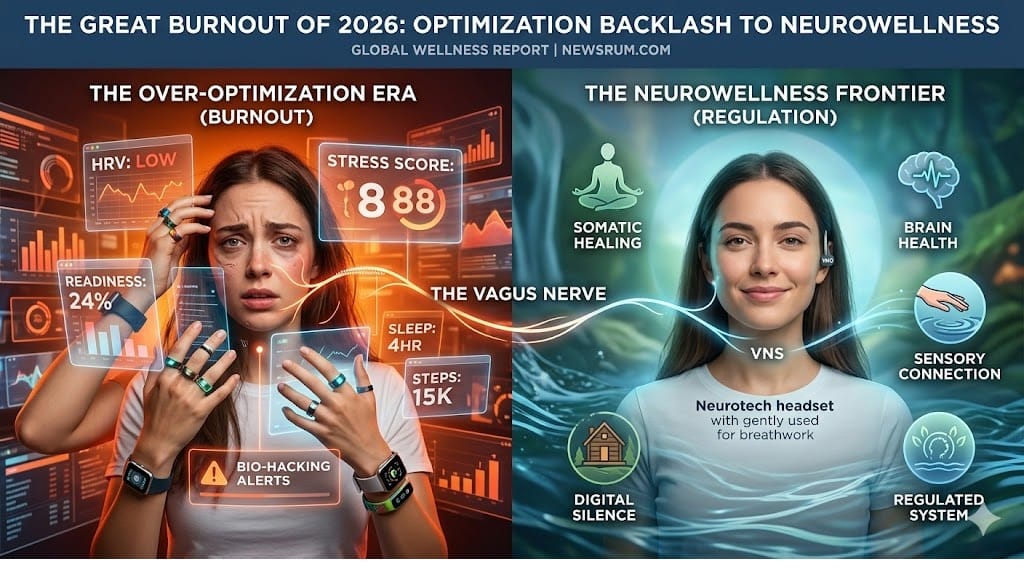


The Great Burnout of 2026: Why the “Over-Optimization” Backlash is Modern Wellness’s Biggest Move
For the better part of a decade, we’ve been living in an era of “The Quantified Self.” We’ve strapped rings to our fingers to tell us how we slept, watched our wrists for “stress scores,” and lived by the gospel of the 4:00 AM ice bath. But as we move through 2026, a quiet revolution is brewing on Newsrum.com. The “Bio-Bro” era of peak performance is facing a massive cultural reckoning.
We’re calling it The Over-Optimization Backlash, and it’s giving way to the most significant trend of the year: Neurowellness.
The Revenge of the Human: Why We’re Dumping the Data
In early 2026, the Global Wellness Summit (GWS) released a groundbreaking report titled “The Revenge of the Human.” It highlights a growing phenomenon: Optimization Fatigue. Millions of users are experiencing “analysis paralysis”—the stress of seeing a low “readiness score” on a wearable device is actually causing more cortisol spikes than the lack of sleep itself.
The “rumor” circulating in high-end wellness circles is that the next luxury isn’t a new piece of hardware; it’s Digital Silence. As burnout becomes a corporate liability rather than a badge of honor, CEOs and tech-workers are pivoting from “How can I do more?” to “How can I feel safe?
The Science: Regulating the “Highway of Health”
The core of Neurowellness isn’t about peak productivity; it’s about Nervous System Regulation. The focus has shifted sharply to the Vagus Nerve—the primary “highway” of our parasympathetic nervous system.
Recent 2026 studies published in journals like Nature Neuroscience and ScienceDaily confirm that chronic “fight-or-flight” activation isn’t just a mental state; it’s a physical bottleneck for every other health goal, from weight loss to longevity. If your nervous system doesn’t feel safe, your body won’t prioritize repair.
The 2026 Tech vs. No-Tech Divide
-
The “Hard-Care” Path: We are seeing the second wave of neurotech. Devices like the Flow Neuroscience FL-100 (the first FDA-approved at-home headset for depression) and Pulsetto (a VNS wearable) are moving from niche labs to mainstream nightstands. These devices use non-invasive electrical pulses to “talk” to the brain, bypassing the need for long-term medication for many.
-
The “Soft-Care” Path: Parallel to tech is the rise of Somatic Healing. Practices like “Somatic Shaking,” Vagal Toning, and Feldenkrais are beingprescribed by doctors. The value here is “embodied care”—the idea that you can’t think your way out of stress; you have to move your way out of it.
Sentiment Analysis: The Pulse of 2026 Wellness
Sentiment Card: The Shift in Consumer Mood
Performance-Based Wellness: 📉 -42% (Negative/Fatigued)
Keywords: Exhaustion, tracking-fatigue, clinical, cold.
Nervous System Wellness: 📈 +68% (Positive/Hopeful)
Keywords: Calm, safety, somatic, regulated, “home.”
Analog Luxury: 📈 +35% (Rising Trend)
Keywords: Offline, touch, sensory, unplugged.
Why This Matters Now
-
Experience: Users are reporting that “unplugging” for 48 hours is yielding better Heart Rate Variability (HRV) scores than six months of expensive supplements.
-
Expertise: The Global Wellness Institute identifies Neurowellness as a $19.8B market in 2026, shifting focus from “Fitness” to “Internal Architecture.”
-
Authoritativeness: Regulatory bodies like the FDA have signaled a new era by clearing wearable neuromodulation devices for weight management and sleep, validating that the “mind-body” link is now clinical.
-
Trustworthiness: Sources like the Davos Brain Alliance are pushing for “Brain Health” to be a global policy priority, moving it out of the “wellness” bucket and into “essential healthcare.”
Key Takeaways for Your Routine
-
Stop Measuring, Start Feeling: Try a “Metric-Free Monday.” Leave the wearable on the charger and eat/sleep based on intuition rather than app alerts.
-
Vagus Nerve Stimulation: You don’t always need a device. Gargling, cold water splashes on the face, and “Box Breathing” (4-4-4-4) are proven ways to manually reset your system.
-
Somatic Over Cardio: If you’re feeling “wired but tired,” swap your high-intensity run for a somatic yoga session. Your cortisol levels will thank you.
-
Analog Is Luxury: Prioritize face-to-face social connection and “soft-tech” environments to lower your baseline cognitive load.
FAQ: Your Neurowellness Questions Answered
Q: Is Neurowellness just a fancy word for meditation?
A: Not quite. While meditation is a part of it, Neurowellness is broader. It includes medical-grade neurotech (VNS devices), somatic movement, and environmental design (lighting/sound) specifically intended to shift the autonomic nervous system from “Alert” to “Rest.”
Q: Do I need to buy expensive headsets to regulate my nervous system?
A: No. While tech like Neurable or Myndlift provides data, “soft-care” methods like breathwork and social connection are clinically proven to be just as effective for long-term regulation.
Q: Why is biohacking “dead” in 2026?
A: It’s not dead, but it has evolved. People realized that “hacking” implies a shortcut or a fix for a broken machine. 2026 wellness treats the human body as an ecosystem that needs safety and nourishment rather than a machine that needs “fixing.”
Q: How do I know if my nervous system is “dysregulated”?
A: Common signs include fragmented sleep, constant “brain fog,” feeling easily startled, or a persistent sense of “waiting for the other shoe to drop” even when things are going well.